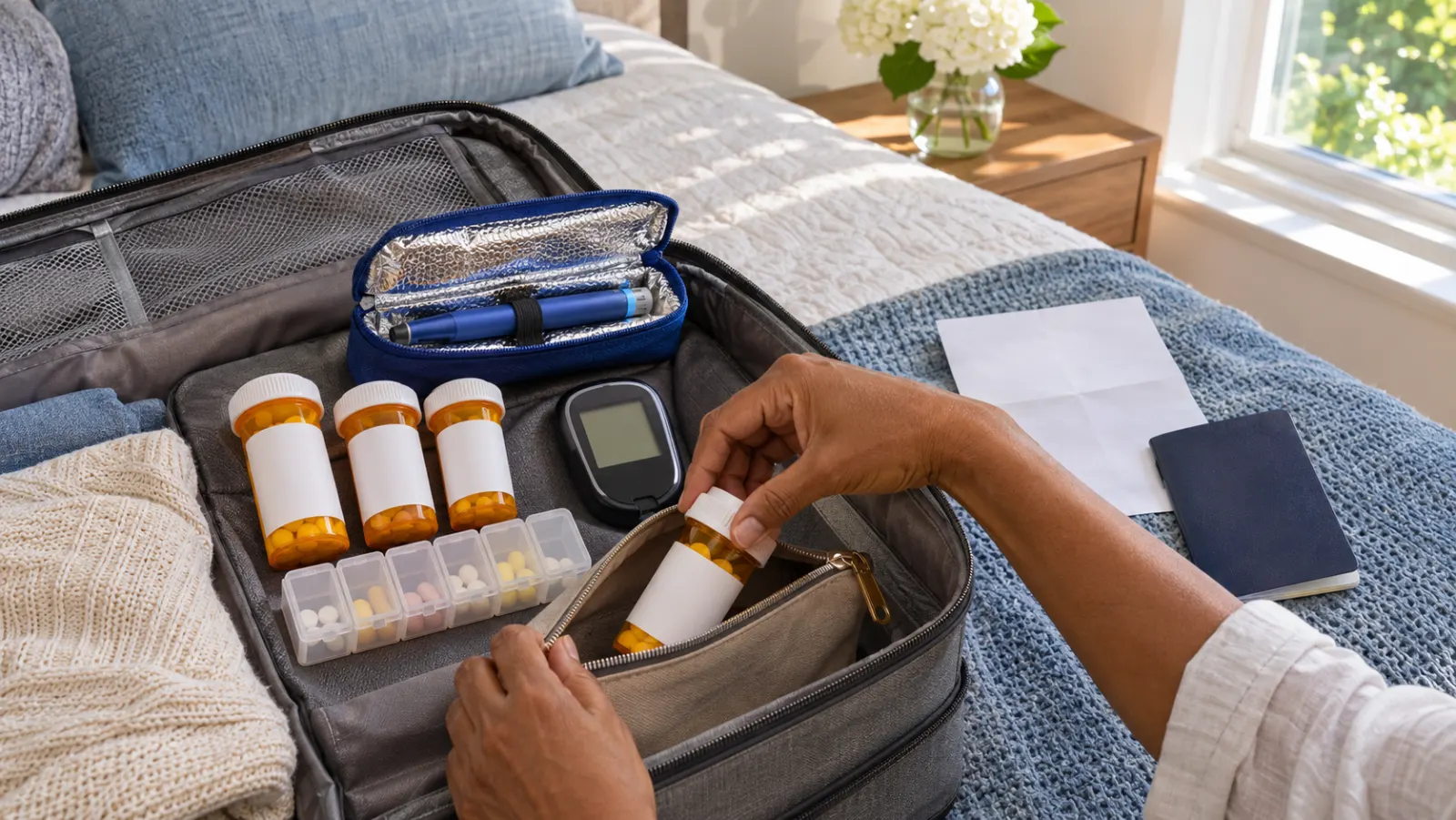
Picture the scene at the check-in counter: a suitcase that is two kilograms over the limit, and a parent unzipping it in front of the queue to move things around. Out come the gifts, the spices, the extra shoes, and somewhere in the shuffle the bag with three months of blood pressure tablets ends up in the checked luggage. Two days later that suitcase is sitting in the wrong airport on the wrong continent.
It happens more often than you might think, and it is one of the most avoidable travel problems there is. For many families in Scarborough, summer trips are long ones: a month with grandparents, a wedding season that stretches across several cities, or a long-awaited visit after years apart. The longer the trip, the more medication you carry, and the more ways that supply can run short, get lost, or be questioned at a border.
This guide focuses on one piece of travel preparation that is easy to leave until the last minute: getting your prescriptions, paperwork and dosing schedule ready to travel with you. It does not cover vaccines or food safety, which are best handled at a separate travel consultation. It is general information, and your own doctor and pharmacist can tailor it to your medications.
Start with an honest count
About a month before you leave, line up every medication you take and count what you actually have. That includes:
- Daily prescriptions such as blood pressure, diabetes, thyroid, cholesterol and heart medications
- Inhalers, both your daily controller and your reliever
- Injectable medications, including insulin and other diabetes or arthritis injections, plus needles, pen tips and testing supplies
- Emergency medications such as an epinephrine auto-injector or nitroglycerin spray
- Birth control
- Vitamins and supplements you take regularly
- Over-the-counter medicines you rely on, like antihistamines or pain relievers
Then compare that count with the number of days you will be away, and add extra. A common rule of thumb is to bring enough for your whole trip plus at least a week or two more, in case of delayed flights, a lost bag, a family emergency that keeps you longer, or a pill that rolls under a hotel bed. Your clinician can help you decide how much buffer makes sense for a longer stay.
Getting enough for a long trip
If you are going away for longer than your usual prescription covers, contact your prescriber well before departure rather than the week you leave. Some drug plans have rules about how much can be dispensed at once, and your pharmacist may need to contact your insurer for a vacation supply. For prescriptions that require regular monitoring, your doctor may want to check blood work or blood pressure before signing off on a larger supply. If you do not have a family doctor, a visit to a walk-in clinic can sometimes cover a renewal, though medications that need ongoing monitoring are best handled by the clinician who knows your history.
Keep it in the original packaging
It is tempting to tip everything into one weekly pill organizer and leave the bulky bottles at home. For travel, that is a bad idea. Customs officers, airline security and doctors abroad all rely on the pharmacy label to know what a medication is, who it belongs to and what dose it contains. Loose, unlabelled pills can cause delays, confiscation or, in some countries, much more serious trouble.
A practical compromise:
- Carry your medications in their original labelled pharmacy containers.
- Make sure the name on the label matches the name on your passport. If your passport uses a different spelling or order of names, mention this to your pharmacist.
- Bring a pill organizer as well if it helps you remember doses, and refill it from the labelled bottles as you go.
- Ask your pharmacist for a printed list of your current prescriptions with generic names, strengths and directions.
Generic names matter abroad
Brand names change from country to country. The tablet you know by one name in Ontario may be sold under a completely different name in India, the Philippines or Jamaica. If you need a replacement while away, the generic name and the strength (for example, the number of milligrams) are what a local doctor or pharmacist will need. Keep that list in your wallet and a photo of it on your phone.
Carry-on, always
Everything essential goes in your carry-on bag, not in checked luggage. Checked bags can be delayed, lost, or stored in an aircraft hold where temperatures can be too hot or too cold for some medications. If you are travelling with a partner or adult child, some people split their supply between two carry-on bags so that a single lost bag does not mean losing everything.
Liquids, gels and sharps at security
Canadian airport security generally allows medically necessary liquids, gels and injectables in your carry-on in amounts larger than the usual liquid limit, but they need to be declared and presented for screening. Needles and pens for insulin and other injectables are generally permitted when you are carrying the medication they go with. Rules change, and the airport you fly home from may follow different ones, so check the current guidance from the Canadian Air Transport Security Authority and your airline before you go, and allow extra time at screening.
The doctor’s letter
A letter from your doctor is not always required, but it can save a lot of explaining. It is especially useful if you are carrying:
- Injectable medications, needles or other medical devices
- Large quantities of medication for a long stay
- Controlled medications such as opioid pain relievers, some sleep or anxiety medications, or stimulants for ADHD
- Medical equipment like a CPAP machine or glucose monitor
A good letter lists your diagnoses in general terms, the medications you take with generic names and doses, and confirms they are prescribed for your personal use. It should be on clinic letterhead and signed. Ask for it at least a couple of weeks before you travel, since letters and forms usually take a little time. Our team can help with medical forms and letters as part of your travel preparation; there may be a fee for forms that OHIP does not cover, which the clinic can explain when you ask.
Controlled medications and destination rules
This is the area where travellers get into the most trouble, often without realising they have done anything wrong. A medication that is completely legal with a prescription in Ontario may be tightly restricted or even prohibited in another country. Examples of medication groups that some countries regulate strictly include:
- Opioid pain relievers, including codeine-containing products
- Stimulants used for ADHD
- Benzodiazepines and some sleep medications
- Medical cannabis, which is illegal in many countries and cannot legally be taken across the Canadian border in any case
Some countries require you to apply for permission before arrival, limit the quantity you can bring, or ask for a specific type of certificate. The rules can also apply to countries you only pass through during a layover. Before you travel, check with the embassy or consulate of each country on your route, and look at the Government of Canada’s travel advice for your destination. Your doctor can help with documentation, but the destination country’s rules are what count at its border.
If you are unsure, ask early
If you take a controlled medication, raise travel plans with your prescriber several weeks before departure. Sometimes there is an alternative that is easier to travel with, or a way to adjust the plan safely for the trip. Never stop a medication suddenly to avoid border paperwork without medical advice; for some drugs that can be dangerous.
Crossing time zones without losing track of doses
Flying from Toronto to South Asia or East Asia can shift your clock by ten to thirteen hours. For many medications, the exact timing is not critical and you can simply switch to local time over a day or two. For others, timing matters more.
Medications where timing is more flexible
For most once-daily tablets, such as many blood pressure or cholesterol medications, the usual approach is to take your dose at your normal home time on the travel day, then shift to the same clock time at your destination. Your pharmacist can tell you whether this is fine for your specific medications.
Medications where timing needs a plan
Some medications need more care when you cross several time zones:
- Insulin. Long flights east or west change the length of your “day”, which can mean too much or too little long-acting insulin if you simply keep to the clock. People using multiple daily injections or insulin pumps often need a specific adjustment plan for the travel days.
- Birth control pills. Progestin-only pills in particular have a narrow timing window. Keeping to home time on the travel day and shifting gradually, or using a backup method, may be advised.
- Seizure medications, some heart medications, and medications for Parkinson’s disease can be sensitive to missed or delayed doses.
- Anticoagulants (blood thinners) need a clear plan so you do not double up or skip doses.
If you take any of these, ask for a written plan before you go. A simple approach many people find helpful is to keep a watch or a second clock on your phone set to Toronto time until you have settled in.
Insulin and diabetes supplies in the heat
If you live with diabetes, travel planning deserves its own visit. July heat in Scarborough is nothing compared with some destinations, and insulin can lose effectiveness if it gets too warm or freezes. Unopened insulin is usually kept refrigerated, while pens in use can often be kept at room temperature for a limited time, depending on the product. Insulated cooling pouches designed for insulin are useful for long journeys and hot climates. Pack:
- More insulin, pen needles and test strips than you think you need
- A glucose meter or reader, with spare batteries or a charger
- Fast-acting sugar for lows, kept within reach during the flight
- Ketone strips, if your clinician recommends them
- Your sick-day plan in writing
Meals on long flights and at family celebrations can be unpredictable, and activity levels change too. A diabetes management review before departure is a good time to talk through dose adjustments, sick-day rules and what to do if your blood sugar runs high or low while you are away.
When something goes wrong abroad
Even well-planned trips hit problems. If you lose medication or run short:
- Contact a local pharmacy or doctor and bring your printed medication list with generic names and doses.
- Call your home pharmacy in Scarborough; they may be able to send information about your prescriptions to a provider abroad.
- Check whether your travel insurance covers replacement medication or a doctor’s visit.
- Do not buy medication from unregulated sellers, street vendors or unknown websites. Counterfeit medicines are a real problem in many parts of the world.
If you become unwell, tell the treating doctor about every medication you take, including anything new you were given during the trip, and keep any paperwork for your doctor back home.
Coming home
When you return, take a minute to compare what is left in each bottle with what should be left. Missed doses, doubled doses or new medications started abroad are all worth mentioning at your next visit. If you saw a doctor while away, book a follow-up appointment and bring the records, especially if anything was changed.
Let us help you pack the medical side
A little planning means your medication is the last thing you need to worry about at the gate. Book a visit a few weeks before departure to review your prescriptions, discuss time zones, and request any letters you might need. If your trip also involves vaccines or malaria tablets, a travel medicine consultation can cover that at the same time.
HealthSmart Medical is a walk-in and family medicine clinic at 2425 Eglinton Ave. East, Unit 12, in Scarborough. Call 416-757-7117 or book online, and bring your current medications or your pharmacy list with you.
This article is for general information and is not a substitute for medical advice. If you have severe or worsening symptoms, call 911 or go to the nearest emergency department.