At a family gathering, it happens almost every time. One cousin’s two-year-old is chattering in full sentences, another is pointing and grunting, and an aunt leans over to ask, kindly but pointedly, “Is he talking yet?” Suddenly a parent who was not worried at all starts counting words in their head on the drive home.
Comparison is natural, but children’s speech and development unfold on their own timelines, within a range that is much wider than most people expect. At the same time, some delays really do benefit from early attention, and parents are often the first to notice that something is off. The goal is not to panic over every late talker or to wait and see indefinitely. It is to know roughly what to expect, to understand which signs are worth raising, and to know what happens once you do.
This guide is written for parents and caregivers in Scarborough, many of whom are raising children in homes where two, three, or more languages are spoken around the dinner table. That last point deserves its own section, because it is one of the most common sources of unnecessary worry.
Development is more than words
When people think of milestones, they often picture first steps and first words. In reality, clinicians look at several connected areas, and a child’s progress in one affects the others:
- Communication: understanding language, using sounds, gestures and words, and taking turns in conversation.
- Social and emotional: eye contact, smiling, sharing attention, interest in other people, managing feelings.
- Gross motor: sitting, crawling, walking, running, climbing, jumping.
- Fine motor: grasping, picking up small objects, scribbling, using utensils.
- Thinking and play: exploring objects, cause and effect, pretend play, problem-solving.
Children commonly race ahead in one area while taking their time in another. An early walker might be a later talker, and that is often perfectly fine. What clinicians look for is the overall pattern, steady progress over time, and any signs of skills being lost.
A rough map of speech and language milestones
The ages below are general guides, not deadlines. Children born early are usually assessed using their adjusted age for the first couple of years. If your child is a little behind on one item but progressing steadily, that is very different from a child who is not moving forward.
Around 6 to 12 months
- Turns toward sounds and voices
- Babbles strings of sounds like “bababa” or “dadada”
- Responds to their name more and more consistently
- Uses gestures such as reaching to be picked up, waving, and, toward the end of the first year, pointing
- Understands simple, familiar words like “no” or “bye-bye,” especially with gestures
Around 12 to 18 months
- Says a first few real words, which may be partial words (“ba” for ball) used consistently
- Points to show you things they find interesting, not just to get things they want
- Follows simple directions with a gesture, such as “give me the cup”
- Brings objects to show you
- Understands far more than they can say
Around 18 months to 2 years
- Vocabulary grows quickly, often with a noticeable burst
- Begins combining two words, like “more milk” or “daddy go,” closer to age 2
- Points to body parts or pictures when named
- Copies words and actions
- Starts simple pretend play, such as feeding a doll
Around 2 to 3 years
- Uses short sentences
- Asks simple questions
- Is understood by familiar people much of the time, even if some sounds are not yet clear
- Follows two-step directions
- Enjoys pretend play and starts playing alongside, then with, other children
Around 3 to 4 years and beyond
- Speaks in longer sentences and tells simple stories
- Is understood by most people, including strangers, most of the time
- Asks “why” questions endlessly
- Uses language to play, negotiate, and describe feelings
Pronunciation develops gradually. Plenty of preschoolers still struggle with sounds like “r,” “l,” “th,” or “s” blends, and that alone is often normal. Your clinician or a speech-language pathologist can tell you which sound errors are expected at your child’s age.
Raising children with more than one language
Walk through any Scarborough playground and you will hear Tamil, Tagalog, Urdu, Cantonese, Somali, Gujarati, Bengali, Arabic, Twi, Spanish, and English, often in the same family. Many parents worry that exposing a toddler to several languages will confuse them or cause a speech delay. Sometimes a relative, a neighbour, or even a well-meaning professional advises dropping the home language and speaking only English.
The research consensus is reassuring: learning more than one language does not cause speech or language delay. Bilingual and multilingual children reach the major milestones, such as first words and combining words, within the same general age ranges as children learning one language.
What is normal in multilingual homes
- Vocabulary is spread across languages. A child may know “water” in English and “milk” in Tamil, but not the reverse. Count words across all languages, not just English.
- Mixing languages is normal. Using words from two languages in one sentence is a sign of a resourceful brain, not confusion. Adults in bilingual communities do it too.
- A quiet period is common. Children who start daycare or school in a new language may say very little in that language for a while as they absorb it.
- One language may become dominant. Usually the language heard most often, especially once school starts.
Why keeping the home language matters
Your home language connects your child to grandparents, culture, faith, and identity. Parents also tend to talk most richly and naturally in the language they are most comfortable with, and that rich talk is exactly what builds language skills. Switching to a less comfortable language can actually reduce the quality and quantity of conversation a child hears. Most professionals encourage families to keep speaking the languages they know best.
When it is not just bilingualism
A true language delay or disorder will show up in all of a child’s languages, not just one. If your child has very few words in any language, is not using gestures, or is having difficulty understanding in their strongest language, that is worth raising, and “they’re just bilingual” should not be the reason to wait. When you see a clinician or speech-language pathologist, tell them which languages your child hears, from whom, and how much.
Signs worth raising with a clinician
Trust your instincts. Parental concern is one of the most useful signals a clinician has, even if you cannot quite name what is bothering you. Bring it up at the next visit, or book a separate appointment, if your child:
- Is not babbling by about 9 months, or not using gestures like pointing or waving by about 12 months
- Is not saying any words by about 15 to 16 months
- Is not combining two words by about 2 years
- Does not seem to understand simple words or directions
- Does not respond consistently to their name or to sounds
- Has speech that is very hard for familiar adults to understand by around age 3
- Shows little interest in interacting, sharing attention, or showing you things
- Is frustrated a great deal because they cannot communicate
- Stutters in a way that is getting worse, causes struggle or tension, or lasts more than several months
- Has delays in several areas, such as walking and talking
Loss of skills is never a wait-and-see sign
If your child stops using words they used to say, stops babbling, stops pointing, or loses social or motor skills they had, contact your doctor promptly. Losing skills at any age needs an assessment.
Urgent situations
Speech development itself is rarely an emergency. However, call 911 or go to the nearest emergency department if a child suddenly cannot speak or understand, has a drooping face, weakness on one side, a seizure, or is unusually drowsy or confused, especially after a head injury.
What a developmental check-in looks like
When you raise a concern, the clinician will usually take a broad look rather than focusing only on words. A growth and development assessment may include:
- Questions about pregnancy, birth, early health, and family history, including relatives with speech, learning, or hearing difficulties
- A milestone review across all areas, often using standard questionnaires
- Watching how your child plays, communicates, and interacts during the visit
- A physical exam, including the ears
- Growth measurements and questions about eating and sleep
- Asking what languages your child hears and how much
Bring notes. A short list of words your child uses in each language, a few examples of how they communicate what they want, and short phone videos of your child talking or playing at home can be very helpful, since many toddlers clam up in an unfamiliar room.
Hearing comes first
Hearing is checked early in almost any speech concern, because a child cannot learn to speak sounds they cannot hear clearly. Even children who passed newborn hearing screening can develop hearing problems later. Frequent ear infections or fluid behind the eardrum can also affect hearing for a time. Your clinician may refer your child for a formal hearing test with an audiologist.
Referrals and supports in Ontario
If the assessment suggests your child would benefit from more help, there are several possible next steps. The exact path depends on your child’s age, the concern, and current local programs, which your clinician can help you navigate.
- Speech-language pathology: Ontario has publicly funded preschool speech and language services for young children. In many areas, parents can refer their child directly, and your doctor can also make or support a referral. School-aged children may be able to access speech-language services through their school board.
- Hearing assessment: referral to an audiologist when hearing needs a closer look.
- Paediatrician or developmental specialist: for broader concerns, delays in several areas, or questions about conditions such as autism. Our specialist referrals page explains how this works.
- Other therapies: occupational or physical therapy when fine or gross motor skills are a concern.
Wait times for some services can be long. That is one reason not to sit on a concern for months. Starting the process early means support arrives sooner if it is needed, and if your child catches up on their own in the meantime, nothing has been lost.
Everyday ways to grow language at home
You do not need special toys or apps. The most powerful tools are time, attention, and talk, in whatever languages your family speaks.
- Narrate your day. “I’m cutting the mango. It’s sweet. Do you want a piece?”
- Follow their lead. Talk about what your child is looking at or playing with.
- Pause and wait. Give your child time to respond, with a look, sound, gesture, or word.
- Expand on what they say. If your toddler says “truck,” you might say “Big red truck!”
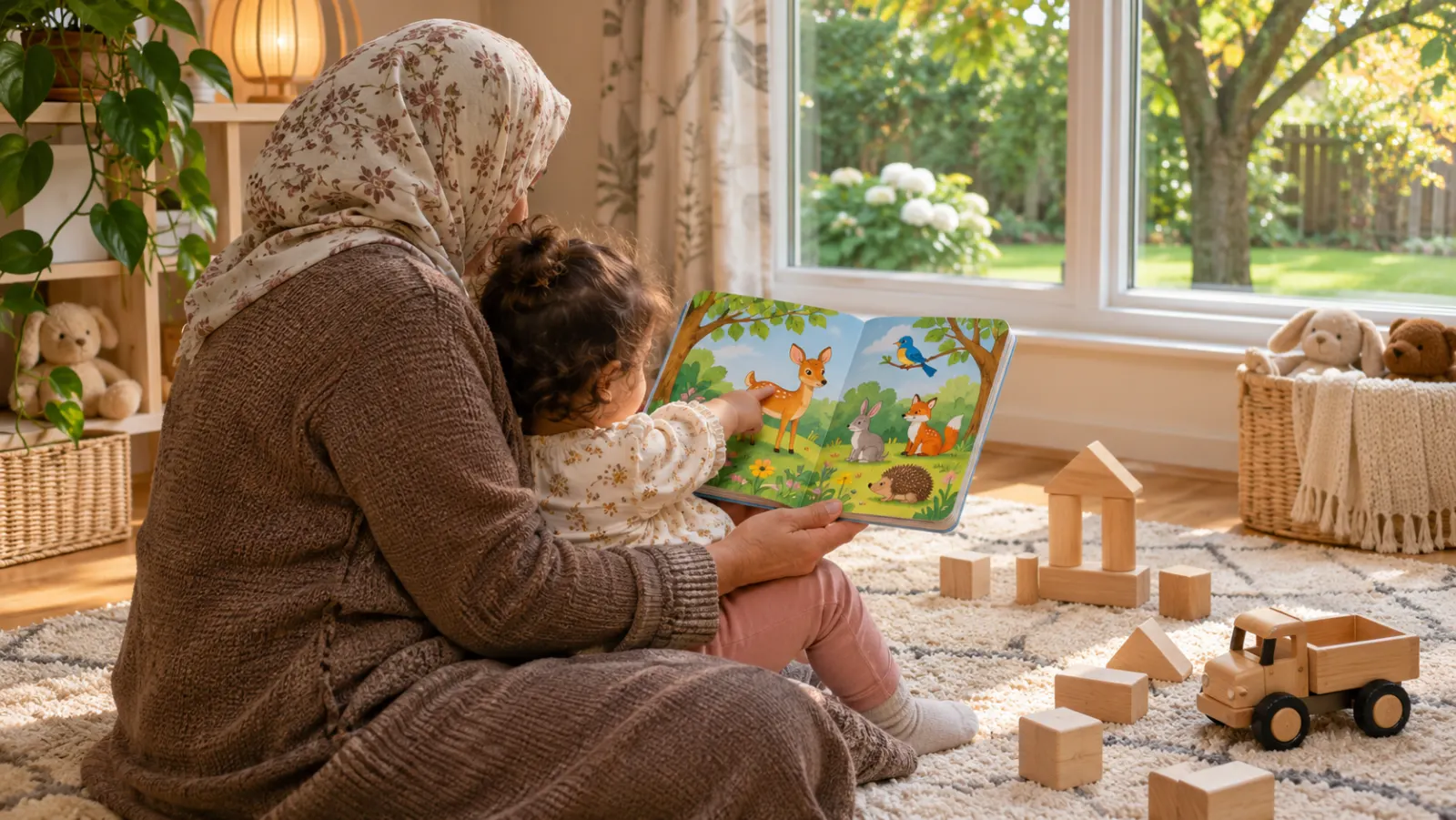
- Read together every day. Point at pictures, ask questions, and let them turn pages. Toronto Public Library branches across Scarborough have books and early literacy programs in many languages.
- Sing songs and rhymes from your own childhood, in your own language.
- Limit background television, which reduces the back-and-forth talk children need.
- Get grandparents involved. In many Scarborough homes, grandparents spend hours each day with toddlers, and their stories and songs are a gift for language development.
As the weather cools this fall, a walk along a neighbourhood trail or through a local park is also a great language outing: leaves, squirrels, buses, puddles, and dogs give you endless things to name and talk about.
Taking the next step in Scarborough
Most children who are a bit slow to talk turn out fine, and many parents leave a developmental visit with reassurance and a few practical ideas. Some children need extra support, and for them, getting started early makes a real difference. Either way, you will have answers instead of a nagging worry.
At HealthSmart Medical, our paediatric care and development visits give families in Scarborough time to talk through speech, play, and milestones, in plain language and with respect for the languages spoken in your home. Find us at 2425 Eglinton Ave. East, Unit 12, call 416-757-7117, or book online. Bring your notes, your videos, and your questions.
This article is for general information and is not a substitute for medical advice. If you have severe or worsening symptoms, call 911 or go to the nearest emergency department.