Most of us have had the experience. You wait for the appointment, you sit in the exam room rehearsing what you want to say, and then the conversation moves quickly, the doctor asks something you were not expecting, and ten minutes later you are back on the sidewalk on Eglinton realizing you forgot to mention the thing that has been bothering you most. By the time you are home, the second question you meant to ask has surfaced too.
This is not a failure on your part. Medical appointments are short, they can feel stressful, and the brain is not at its best when it is worried about a symptom. The good news is that a small amount of preparation makes a surprisingly large difference, both for you and for the clinician trying to help you.
This guide is about the practical side of seeing a doctor: what to write down, what to bring, how to involve family members or an interpreter, how to ask questions so you actually get answers, and what to do after you leave. It applies whether you are seeing your regular family doctor, stopping in at a walk-in clinic, or meeting a specialist for the first time. As the days shorten in late October and cold-and-flu season picks up, clinics in Scarborough get busier, which makes a well-prepared visit even more valuable.
Start with the reason you are coming
Before anything else, try to answer one question in a single sentence: What do I most need from this visit?
It might be “I want to find out why I have been so short of breath on the stairs,” or “I need my blood pressure medication renewed and I want to ask whether the dose is still right,” or “My knee has been swelling for three weeks.” Having that sentence ready means you can say it in the first minute, before the conversation drifts.
Rank your concerns
Many people arrive with several issues, which is completely understandable, especially if it has been a while since your last visit. Write them all down, then put them in order of importance. Put the one that worries you most at the top, even if it feels embarrassing. Doctors hear about bowel habits, sexual problems, low mood, and strange lumps every day. The concerns people leave until the end, when the clinician is already standing up, are often the ones that matter most.
Be prepared that a long list may not all fit into one appointment. A clinician may handle the most urgent items today and suggest a follow-up appointment for the rest. That is not a brush-off. A complicated problem deserves proper time rather than a rushed answer squeezed in at the end.
Describe symptoms like a detective
When you are explaining a new symptom, details are what help a clinician narrow down the possibilities. A few notes on your phone in the days before the visit can capture them before they fade.
Useful things to record include:
- When it started, and whether it came on suddenly or gradually
- Where it is, and whether it moves or spreads anywhere
- What it feels like: sharp, dull, burning, pressure, aching, tingling
- How often it happens and how long each episode lasts
- What makes it better or worse: food, movement, rest, time of day, cold air, stress
- What you have already tried, including home remedies and over-the-counter medicines, and whether they helped
- Anything else that changed around the same time: a new medication, a trip abroad, a new job, a fall, a change in diet
If the problem comes and goes, such as a rash, a swollen joint, or a child’s breathing at night, a photo or short video taken while it is happening can be very helpful. Rashes in particular have a habit of fading on the morning of the appointment.
For ongoing conditions, bring your own numbers if you track them. Home blood pressure readings, glucose logs, a headache diary, or a record of your child’s temperatures are far more useful than “it has been high sometimes.”
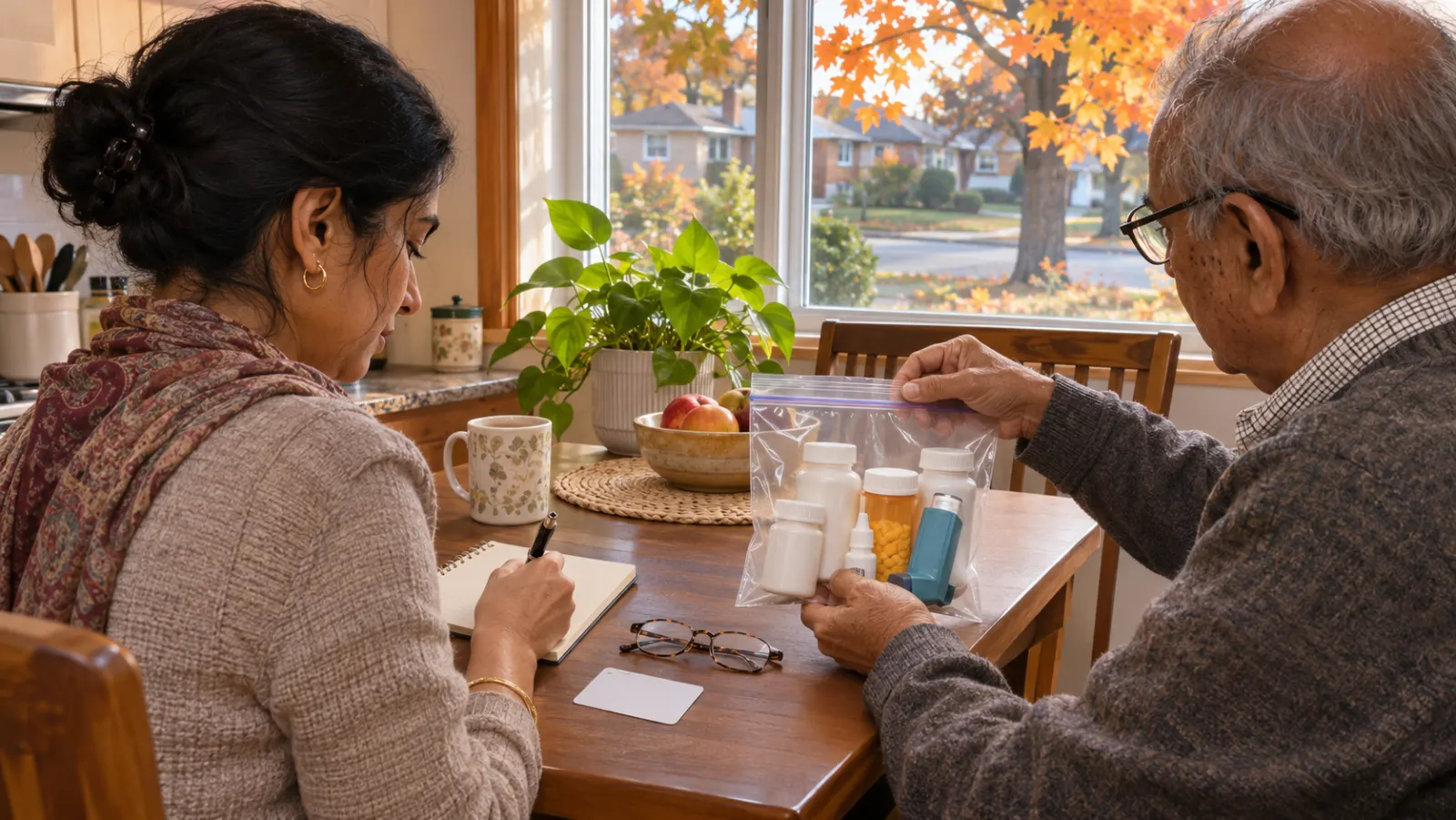
Bring the bag of pills
One of the most useful things you can do is literally put every medication you take into a bag and bring it with you. This is sometimes called a “brown bag” review, and it often uncovers surprises.
Include:
- Prescription medications, in their original containers if possible
- Inhalers, creams, eye drops, patches, and injectables
- Over-the-counter products such as pain relievers, antacids, sleep aids, and allergy pills
- Vitamins, minerals, and supplements
- Herbal remedies and traditional medicines, including those brought from home countries or sent by relatives
That last category matters more than many people realize. Some herbal and traditional products interact with prescription medicines or affect blood sugar, blood pressure, or bleeding. Your clinician is not there to judge what you take, only to make sure everything is safe together. If a product’s label is not in English, bring it anyway.
If carrying everything is impractical, a clear photo of each label works well. Older adults on many medications may benefit from a dedicated review appointment; our separate article on medication reviews for seniors covers that in more depth.
Paperwork and records worth having on hand
A few items can save time and repeat testing:
- Your OHIP card, or other insurance details if you are not yet covered
- Results or reports from tests done at another clinic, hospital, or lab, especially if they are recent
- Discharge papers from any recent emergency or hospital visit
- Vaccine records, including those from outside Canada
- Names of any specialists you see
- Any forms you need completed, with the sections you can fill in already done
If you recently arrived in Canada, records from your previous doctor can be useful even if they are in another language. Your clinician can decide which details matter.
Bringing family, a friend, or an interpreter
In Scarborough, it is common for a daughter to bring her father, a grandson to help with translation, or a spouse to come along as a second set of ears. This kind of support can make visits much more productive, and it is welcome. A few thoughts on doing it well:
A support person’s job
A good support person helps you remember, takes notes, and asks for clarification when something is unclear. They can be especially valuable when the news is complicated, when memory is a concern, or when the patient feels anxious. Agree before the visit on what they will help with. Some patients want their family member to do most of the talking; others want them to stay quiet unless asked.
Keep the patient at the centre
Even when a relative is helping, the appointment is about the patient. Clinicians will usually speak directly to the patient and ask for their own description of symptoms, and that is intentional. It helps if the support person resists the urge to answer for them unless the patient asks for help.
Privacy matters
Some topics are sensitive. A teenager, an older parent, or a spouse may have things they want to discuss privately. It is normal for a clinician to ask a family member to step out for part of the visit, and nobody should take offence. Patients have a right to confidential care, and that sometimes includes a few minutes alone.
When language is a barrier
Medical words are hard even in a language you know well. If English is not your first language, consider whether a family member is truly the best interpreter. Children in particular should not be put in the position of interpreting difficult or private health information for parents. If you would prefer a professional interpreter, or if a support person needs to join by phone, mention it when you book so the team can let you know what is possible. Whatever arrangement you use, it is fine to ask the clinician to slow down or explain something again.
Asking questions that get useful answers
Many patients hold back questions because they do not want to take up time or seem difficult. Asking is part of good care. Clinicians would much rather answer a question in the room than have you go home confused about your treatment.
Three questions that cover a lot of ground
A simple framework used in many patient education programs is to make sure you can answer three things before you leave:
- What is my main problem?
- What do I need to do about it?
- Why is it important for me to do this?
If you cannot answer all three, ask.
Other questions worth considering
- What else could this be, and what would make you think differently?
- What are the side effects of this medication, and which ones should I call about?
- How long before I should expect to feel better?
- Is there anything I should avoid while I recover, such as driving, lifting, or certain foods?
- What happens if I decide not to take this treatment?
- When should I come back, and what should make me come back sooner?
Repeat it back
One of the best ways to check your understanding is to repeat the plan in your own words: “So I take this pill once a day with food, I get blood work next week, and I come back in a month unless the pain gets worse.” This is sometimes called the teach-back method. It catches misunderstandings on the spot, and clinicians generally appreciate it.
Write the plan down, or ask your support person to. Memory after an appointment is notoriously unreliable, especially when a new diagnosis has been mentioned.
Visits by phone or video
Not every visit happens in person. If your appointment is a phone or video call, the same preparation applies, with a few additions. Find a quiet, private spot, have your medications and notes within reach, and keep a pen handy. For video, check your connection and camera beforehand, and make sure the room is well lit if you will need to show a rash or a swollen joint. Our virtual care page explains which kinds of concerns suit a remote visit.
After you leave: the part people forget
The appointment does not end when you walk out the door. Some of the most important steps happen afterward.
Know how results will reach you
If blood work, imaging, or a referral has been ordered, ask how you will hear about the results and roughly when. Do not assume that no news means good news. If you expected to hear back and have not, it is reasonable to call the clinic.
Follow the referral trail
Specialist referrals can take time, and occasionally a fax goes astray or a contact number is out of date. Make sure the clinic has your current phone number. If you have heard nothing after a reasonable period, call to check the status. Our team can help with specialist referrals and with tracking where things stand.
Fill prescriptions promptly
It sounds obvious, but many prescriptions are never picked up. If cost, side effects, or confusion about how to take a medicine is getting in the way, tell your clinician or pharmacist. There may be an alternative. Your pharmacist is also an excellent resource for questions about timing, food, and interactions.
Keep your own record
A simple folder or phone note with your diagnoses, medications, allergies, test results, and important dates is useful for everyone, and especially for people who see several clinicians. It also makes the next visit easier to prepare for.
When preparation should not slow you down
Everything above is for planned visits. Some situations should never wait while you write a list.
Call 911 or go to the nearest emergency department for:
- Chest pain or pressure, especially with sweating, nausea, or shortness of breath
- Sudden weakness or numbness of the face, arm, or leg, trouble speaking, or a drooping face
- Severe difficulty breathing
- A sudden, severe headache unlike any before
- Fainting, confusion, or a seizure
- Heavy bleeding that will not stop
- Thoughts of harming yourself or others
If you are unsure whether something needs urgent care, you can call Health811 any time to speak with a registered nurse.
Come prepared to HealthSmart Medical
A focused list, a bag of medications, and a willingness to ask questions can turn a rushed visit into a genuinely useful one. Whether you need family medicine and ongoing care or a quick walk-in visit for something new, our team in Scarborough is happy to work through your concerns with you.
HealthSmart Medical is at 2425 Eglinton Ave. East, Unit 12, in Scarborough. You can book online or call 416-757-7117. Bring your notes, bring your pill bag, and bring your questions.
This article is for general information and is not a substitute for medical advice. If you have severe or worsening symptoms, call 911 or go to the nearest emergency department.