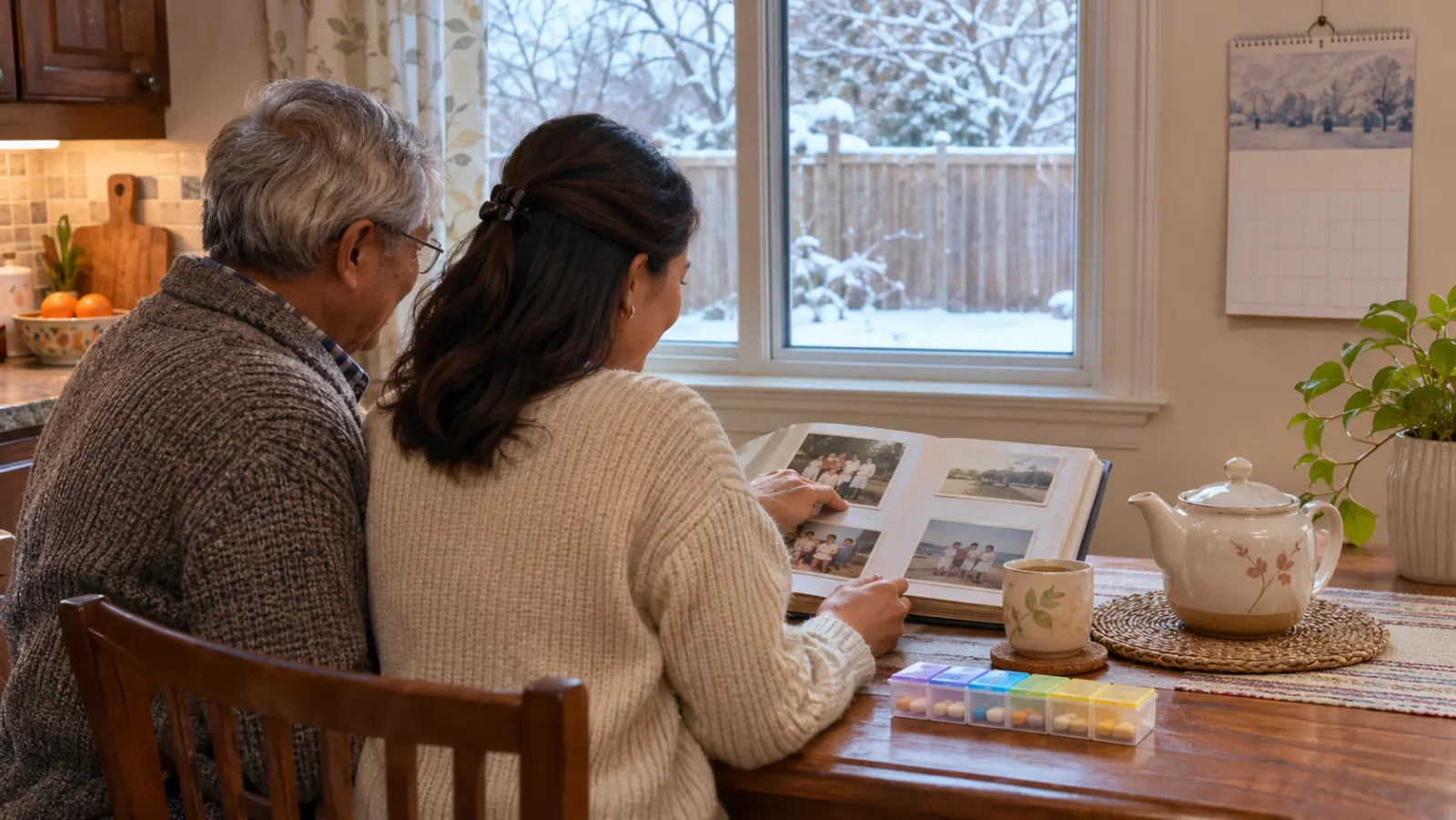
It often starts with something small. Your mother asks the same question about Sunday dinner three times in an hour. Your husband, who has driven to the same Scarborough grocery store for twenty years, calls to say he is not sure which way to turn. Or maybe it is you: you walk into a room and forget why, lose a word halfway through a sentence, and quietly wonder whether this is the beginning of something.
Worry about memory is one of the most common reasons older adults and their families come to see a family doctor, and it is also one of the most frightening to bring up. Many people put it off for months or years because they are afraid of what they might hear. Yet a lot of memory trouble turns out to have a cause that can be treated, and even when dementia is the answer, an early diagnosis gives people time to plan, get support and stay in charge of their own decisions.
This guide walks through how normal ageing differs from warning signs, the conditions that can imitate dementia, what a memory assessment involves, and how families in Scarborough can support someone through it. It is general education, not a substitute for seeing a clinician.
What normal ageing looks like
The brain changes with age, just like the knees and the eyes. Most healthy older adults notice that:
- Names come back more slowly, sometimes hours later
- It takes longer to learn a new phone or a new TV remote
- Multitasking is harder than it used to be
- They occasionally misplace glasses or keys but can retrace their steps to find them
- They forget an appointment now and then but remember it later or with a reminder
These changes are irritating, but they do not stop someone from managing their life. A person who forgets a neighbour’s name but still pays the bills, cooks familiar meals, takes medications correctly and finds their way around the neighbourhood is usually describing ordinary ageing.
Warning signs that deserve a doctor’s visit
Dementia is not a single disease. It is a general term for a decline in memory and thinking that is serious enough to interfere with daily life. Alzheimer’s disease is the most common cause, and vascular dementia, linked to blood vessel damage in the brain, is another. There are other types as well.
Signs that something more than normal ageing may be happening include:
- Memory loss that disrupts daily life, such as forgetting recent conversations entirely, repeating questions, or relying on family for things the person used to handle
- Trouble with familiar tasks, like following a long-loved recipe, using the stove, or managing the TTC route they have taken for years
- Getting lost in familiar places, or losing track of the date or season
- Problems with words, such as stopping mid-sentence, calling things by the wrong name, or struggling to follow a conversation
- Poor judgement, for example giving large sums of money to telephone scammers or dressing for summer in January
- Difficulty with planning and money, including unpaid bills, unopened mail or confusing bank statements
- Changes in mood or personality, such as new suspicion, anxiety, irritability or withdrawal from friends and community events
- Misplacing things in odd places, like keys in the freezer, and being unable to retrace steps, sometimes accusing others of taking them
In families where an older relative speaks a different first language from their children or grandchildren, early changes can be harder to spot. Some people also lose a later-learned language before their first language, so a grandparent who has always spoken English may start to rely more on Tamil, Cantonese, Tagalog or Urdu. That shift is worth noticing.
Sudden confusion is different
A memory change that develops slowly over months is something to book an appointment for. Confusion that appears suddenly, over hours or a few days, is different. It may be delirium, which can be caused by an infection, dehydration, a medication reaction, or another acute illness, and it needs prompt medical assessment.
Call 911 right away if someone suddenly develops confusion along with facial drooping, arm weakness, slurred or jumbled speech, a severe headache, trouble seeing or walking, or if they cannot be woken properly. These can be signs of stroke or another emergency.
Causes of memory trouble that can be treated
Before anyone uses the word dementia, a careful doctor looks for other explanations. Some of the most common include:
Thyroid problems
An underactive thyroid can slow thinking, cause tiredness and make concentration difficult. A simple blood test can check thyroid function, and if it is low, treatment is usually straightforward. HealthSmart Medical offers ongoing thyroid disorder management for patients who need it.
Low vitamin B12
Vitamin B12 is needed for healthy nerves and brain function. Levels can fall in older adults, in people who eat little or no animal products, and in those taking certain long-term medications, including some used for diabetes and stomach acid. Low B12 can cause memory problems, numbness or tingling, and fatigue.
Medications
Many common medicines can cloud thinking, especially in older bodies that process drugs more slowly. Sleeping pills, some allergy and bladder medicines, certain pain medications, and combinations of several prescriptions are frequent culprits. Over-the-counter sleep aids that contain antihistamines are a common hidden factor. Bring every pill bottle, including supplements and remedies from overseas, to the appointment so your doctor can see the full list.
Depression and anxiety
In older adults, depression can look remarkably like dementia: slowed thinking, poor concentration, withdrawal and memory complaints. It is sometimes called “pseudodementia” because thinking often improves once the mood is treated. The two can also happen together, so both deserve attention.
Other contributors
- Poor sleep, including untreated sleep apnea
- Hearing loss and vision problems, which make it hard to take in information in the first place
- Heavy alcohol use
- Infections, especially urinary tract infections in frail older adults
- Dehydration, low sodium, or blood sugar problems
- Grief, loneliness and social isolation, which can follow retirement, widowhood or a move to a new country
What a memory assessment involves
There is no single test for dementia. Instead, a family doctor pieces together information from several sources over one or more visits.
The conversation
Your doctor will ask what changes have been noticed, when they started, and whether they are getting worse. Hearing from a family member or close friend is very helpful, because the person experiencing memory loss may not notice everything. Some families find it easier to write down examples before the visit, such as “missed two doctor’s appointments in December” or “left the stove on twice this month.”
Cognitive screening
A short set of pencil-and-paper or verbal tasks checks memory, attention, language and problem solving. These screening tools are not perfect, and results can be affected by education level, language and culture. If the person is more comfortable in a language other than English, let the clinic know so the team can discuss how best to do the assessment.
Physical examination and tests
The doctor may check blood pressure, heart rhythm, hearing, vision, balance and reflexes. Common next steps include:
- Blood work for thyroid function, B12, blood count, kidney and liver function, blood sugar and electrolytes
- A brain scan in some situations, arranged through diagnostic imaging referrals
- A review of all medications
Specialist input
Some people need a more detailed assessment by a geriatrician, neurologist, geriatric psychiatrist or a memory clinic. Your family doctor can arrange a specialist referral when it would help clarify the diagnosis or guide treatment.
If the diagnosis is dementia
Hearing the word can be devastating, and it is normal to feel shock, sadness, fear, or even relief at finally having an explanation. A diagnosis is also a starting point for useful action.
Treatment and brain-healthy habits
There are medications that can help with some symptoms of certain types of dementia for some people, and your doctor or specialist can talk through whether they are appropriate. Beyond medication, the same habits that protect the heart tend to protect the brain:
- Keeping blood pressure, cholesterol and blood sugar under control
- Staying physically active, even with daily walks or chair exercises
- Staying socially connected through family, faith communities, seniors’ programs and friends
- Treating hearing loss, which is linked with faster cognitive decline
- Not smoking and limiting alcohol
- Keeping up routines that bring meaning, whether that is gardening on the balcony, cooking, music or prayer
Planning while the person can take part
Early diagnosis allows the person with dementia to make their own wishes known. Families may want to:
- Talk about future care preferences, including where the person would want to live
- Set up powers of attorney for personal care and for property, with help from a lawyer if needed
- Organise banking, bills and important documents
- Consider safety at home, including the stove, medications and wandering risk
Driving
Driving is often the hardest topic. Doctors in Ontario are required to report certain medical conditions that may make driving unsafe, and dementia can be one of them depending on its effect. Your doctor will discuss this openly. Many families find it helps to plan other ways of getting around, such as rides from relatives, Wheel-Trans eligibility, or community transportation services, before the car keys become a crisis.
Supporting someone you love
Caring for a parent, spouse or grandparent with memory loss can be deeply meaningful and exhausting at the same time. In many Scarborough households, care is shared across generations under one roof, which has real advantages but can also mean one person quietly carries most of the load.
Some practical tips:
- Keep routines predictable. Regular meal and sleep times reduce confusion.
- Simplify, do not argue. If your father insists it is 1985, correcting him repeatedly may cause distress. Gentle redirection often works better.
- Use visual cues. Calendars, labelled cupboards, pill organisers and a clock showing the day and date can help.
- Protect against scams. People with memory loss are frequent targets of phone and online fraud.
- Look after yourself. Ask about community support services, adult day programs and respite care. Caregivers who burn out cannot help anyone.
- Connect with support organisations. Groups such as the Alzheimer Society offer education and caregiver support, and your doctor’s office can point you toward local resources.
Talking to a doctor about memory in Scarborough
If you are worried about your own memory or someone else’s, you do not need to wait until things are obvious. At HealthSmart Medical, 2425 Eglinton Ave. East, Unit 12, our clinicians can listen to your concerns, look for treatable causes, arrange testing and referrals, and see you for regular follow-up appointments as things change. Family members are welcome to come along, with the patient’s permission.
Call 416-757-7117 or book online. Asking the question early is not giving up. It is how families in Scarborough protect the independence, dignity and time together that matter most.
This article is for general information and is not a substitute for medical advice. If you have severe or worsening symptoms, call 911 or go to the nearest emergency department.