“I had malaria three times as a child. I know what it looks like, and I know how to handle it.” Clinicians who see travellers hear some version of this all the time, often from people who have lived in Scarborough for ten or twenty years and are about to fly back to Lagos, Accra, Port-au-Prince or a village in Odisha for a family celebration. It is said with confidence, and it comes from real experience. Unfortunately, it is also one of the most dangerous assumptions a traveller can make.
Malaria is a parasite infection spread by mosquito bites. It can go from a fever and a headache to a life-threatening illness within a day or two, particularly with the species most common in sub-Saharan Africa. In Canada, a large share of imported malaria is seen in people who travelled to visit friends and relatives, and many of them did not take preventive medication.
This article is written for those travellers. It explains why the protection you had growing up does not travel with you, how preventive tablets work in practice, how to make bite prevention realistic when you are staying in a family home, and why a fever after you come back is something to act on quickly.
Why “I grew up there” does not protect you
Partial immunity is real, but it is temporary
People who grow up in areas with constant malaria exposure often develop what is called partial immunity. They still get infected, but repeated exposure trains the immune system to keep the parasite in check, so adults in those areas may have milder illness than a visitor would.
That protection depends on being bitten again and again. Once you move away, it fades, and after a few years in Canada it cannot be relied on at all. The body does not keep the memory the way it does after many vaccines. Returning to the same village does not switch it back on in time to help during a two- or four-week visit.
Your children never had it
Children born and raised in Scarborough have never been exposed. They have no partial immunity whatsoever, and young children can become seriously ill very quickly. Of all the people in a travelling family, they need protection the most.
The other things that raise risk on family visits
Visiting relatives often involves exactly the conditions that favour mosquito bites:
- Longer stays, sometimes several weeks or months
- Homes without screens, air-conditioning or bed nets
- Evenings outdoors for weddings, funerals, religious gatherings and family dinners
- Travel to rural areas and smaller towns where malaria is more common
- Visits during or just after the rainy season, when mosquito numbers climb
None of this means you should not go. It means the trip deserves a proper plan.
How preventive malaria tablets work
There is no malaria vaccine for travellers
Malaria vaccines exist and are now being used for young children in some African countries, but they are not used for travellers from Canada. For travellers, the protection comes from preventive medication, sometimes called chemoprophylaxis, together with bite prevention.
The main options, in general terms
Several antimalarial medications are used for prevention. Which one is right depends on your destination (because resistance patterns vary), your health, other medications, pregnancy, age, cost and how long you will be away. In broad strokes:
- Some are taken daily, starting a day or two before entering the malaria area, continuing throughout the stay, and for a short period after leaving.
- Some are taken daily but need to be continued for several weeks after you return.
- Some are taken once a week, starting a week or more before travel, which can suit long stays but is not suitable for everyone.
Each medication has its own side effects and reasons it might not suit a particular person. Some can make skin more sensitive to the sun, some can upset the stomach, and some are not used in people with certain mental health or heart conditions. That is why the choice is made at a malaria prevention consultation rather than by following what a relative took.
Getting the details right
Antimalarials only work if they are taken correctly. A few habits help:
- Start on time. If your tablets need to start before departure, set a reminder on your phone.
- Take them with food and water if directed, which can reduce stomach upset.
- Do not stop when you get home. The after-travel portion of the course is there because parasites may already be developing in your liver. Stopping early is one of the most common reasons travellers get sick weeks later.
- Bring enough. Pack the full course plus a few extra in your carry-on.
- Do not swap in local tablets. Medications bought abroad may be a different drug, a different dose, or counterfeit. Some older drugs still sold in certain markets no longer work well against local strains.
Children, pregnancy and other special situations
Children can take preventive medication, with doses based on weight; tablets can sometimes be crushed and mixed with something sweet. Pregnancy changes the picture a great deal. Malaria is more dangerous during pregnancy for both parent and baby, and some antimalarials are not recommended, so pregnant travellers are often advised to avoid malaria areas if they can. If you are pregnant or may become pregnant, say so at the start of your appointment.
People with kidney or liver disease, epilepsy, heart rhythm problems or weakened immune systems, and anyone taking several regular medications, should mention this too. A pre-travel medical evaluation can look at the whole picture.
Stopping the bite in the first place
Tablets reduce the chance that a bite turns into illness. Bite prevention reduces the number of bites. Using both is far better than relying on either alone, and bite prevention also protects against dengue, chikungunya, Zika and other mosquito-borne infections that tablets do nothing for.
Repellent that actually gets used
The best repellent is the one you will put on every evening. Products containing DEET or icaridin are widely recommended and available in Canada. Follow the label for how often to reapply and for age restrictions, which matter for babies and young children. If you also use sunscreen, apply sunscreen first and repellent on top.
Dressing for the evening
The mosquitoes that carry malaria mainly bite from dusk until dawn. For evening gatherings:
- Wear light-coloured, loose long sleeves and long pants
- Tuck pants into socks if you will be outside in grass or near standing water
- Consider clothing treated with permethrin, an insecticide applied to fabric rather than skin; it can be bought pre-treated or applied before you leave
Sleeping protected
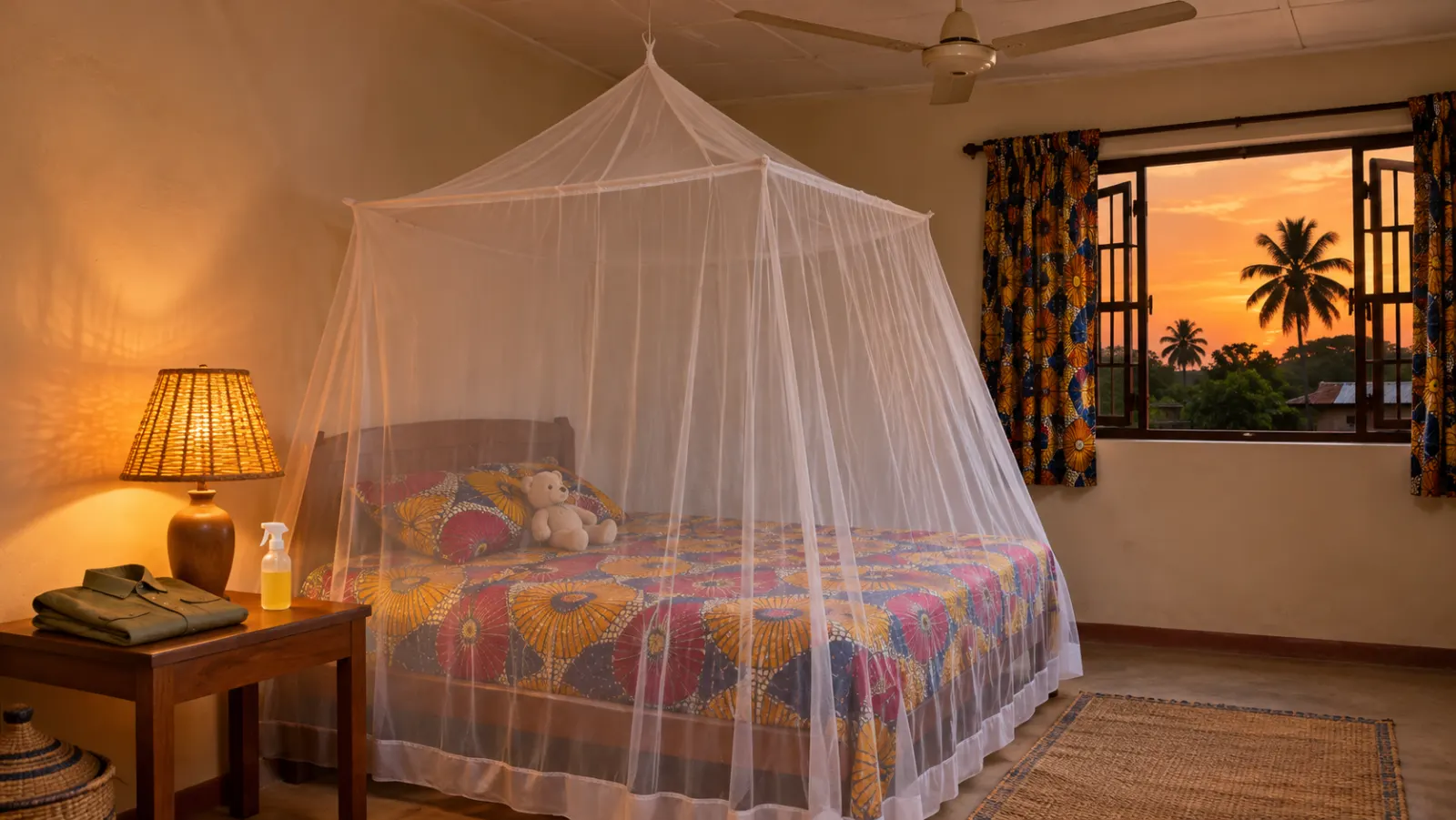
In a family home without screens or air-conditioning, a bed net is one of the most effective things you can use. Bring your own insecticide-treated net if you are not sure one will be available, check it for holes, and tuck the edges under the mattress. Children and grandparents sharing a room can sleep under one larger net. Fans help too, since mosquitoes struggle to fly in moving air. Plug-in vaporizers and coils can add a little protection but should not be the main plan.
Talking to family
Sometimes the harder part is social. Relatives who live with malaria every day may see your nets and repellent as fussing. It can help to explain that your doctor in Canada told you that your immunity is gone and that your children have none at all. Bringing extra repellent as a gift for the household is another approach that tends to land well.
After you come home: the fever rule
This is the section to remember even if you forget everything else.
Any fever within the first few months after returning from a malaria area should be treated as possible malaria until proven otherwise. Malaria symptoms can include fever, chills, sweats, headache, muscle aches, tiredness, nausea, vomiting or diarrhea. They often feel like the flu, which is exactly why they get dismissed. Symptoms usually appear within the first month or so, but some types of malaria can show up many months later, even up to a year after travel, and even if you took your tablets perfectly.
What to do
- Get tested the same day. Malaria is diagnosed with a blood test, and the result is needed quickly. A hospital emergency department is generally the right place to go for a fever after travel to a malaria area, because testing and treatment can be done promptly there.
- Tell them where you were. Say clearly, “I have been in [country] in the last [weeks or months].” Do not wait to be asked.
- Do not self-treat. Leftover tablets from abroad, or treating it as a cold at home, can delay the diagnosis.
- Repeat testing may be needed. A single negative test does not always rule malaria out if symptoms continue.
Call 911 or go to emergency immediately for
- Confusion, drowsiness, seizures or fainting
- Difficulty breathing
- Yellowing of the skin or eyes, or very dark urine
- Repeated vomiting, or being unable to keep fluids or medications down
- A child with fever who is floppy, unusually sleepy, or not drinking
For fevers that start well after the malaria window, or in people who did not travel, a fever assessment at the clinic is a reasonable first step. When in doubt about where to go, Health811 can help you decide.
A simple timeline for families travelling from Scarborough
- As soon as flights are booked: book a travel appointment, ideally six to eight weeks before departure. Bring the full itinerary, including villages and side trips, and everyone’s medication lists.
- A few weeks before: fill prescriptions, buy repellent and a bed net, and treat clothing if planned.
- The days before departure: start tablets if your schedule calls for it, and set reminders.
- During the trip: take tablets every day or every week as directed, use repellent each evening, and sleep under a net.
- After returning: finish the full course, and keep the fever rule in mind for the months ahead.
Even if your trip is days away, it is still worth coming in. Many preventive tablets can be started shortly before departure, and bite prevention advice applies no matter what.
Planning a safer trip home
Going back to see family is one of the most meaningful journeys people in Scarborough make. A short appointment can help make sure the memories you bring back are of the wedding, the food and the cousins, not a hospital bed.
HealthSmart Medical offers travel clinic services at 2425 Eglinton Ave. East, Unit 12, in Scarborough. Call 416-757-7117 or book online, and bring your itinerary, your travel dates and a list of every medication each family member takes. We will help you choose a malaria plan that fits your destination and your family.
This article is for general information and is not a substitute for medical advice. If you have severe or worsening symptoms, call 911 or go to the nearest emergency department.