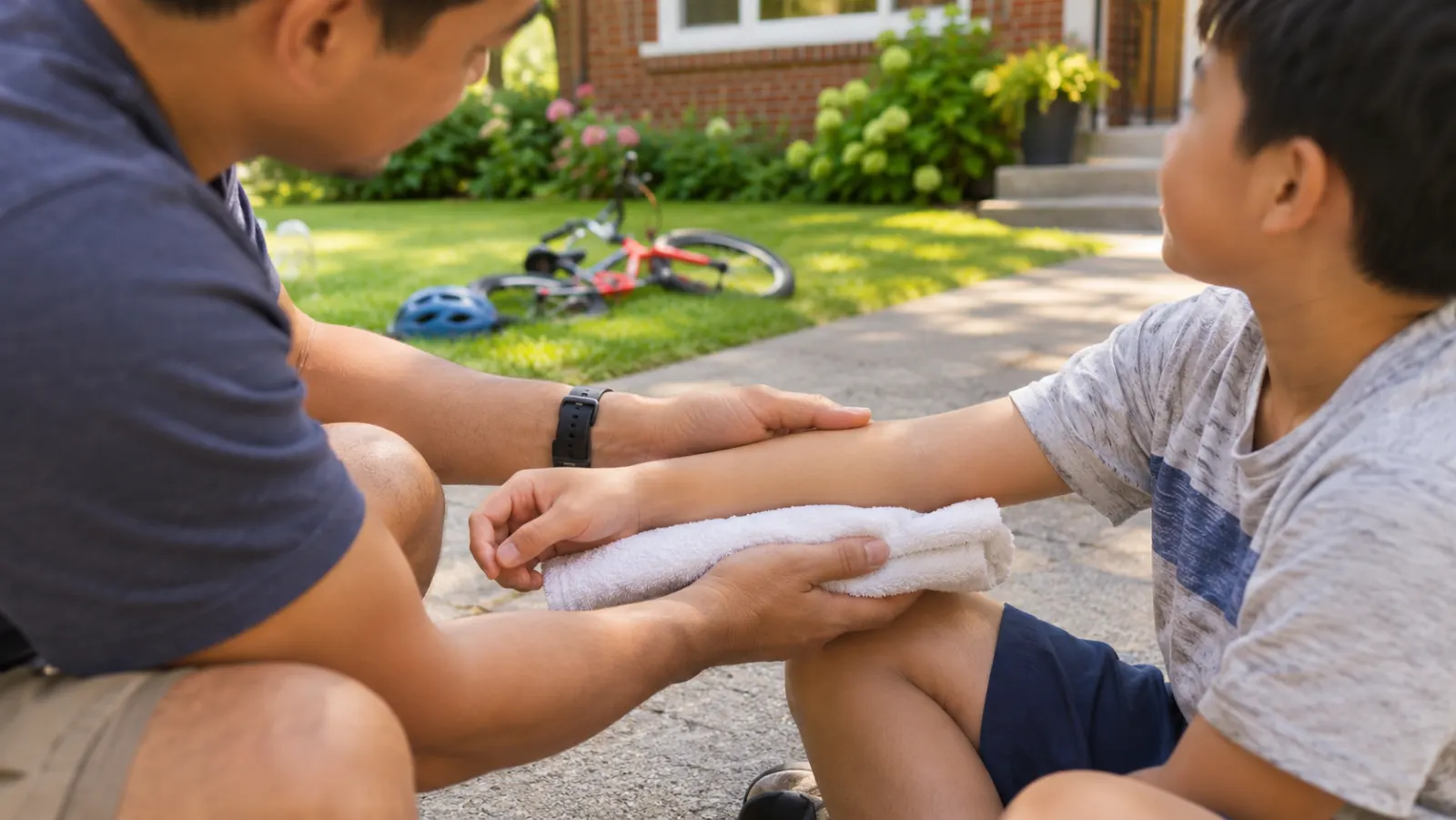
“Can you move it? Then it’s not broken.” Almost every family has someone who says this, usually an uncle or grandparent, usually with total confidence. It’s also one of the most persistent myths in first aid. Plenty of people walk around for days on a cracked wrist bone or a broken toe because they could still wiggle their fingers.
Mid-August is peak season for these questions in Scarborough. Kids are spending long days on bikes, scooters and trampolines before school starts. Adults are playing weekend sports, climbing ladders to clean eavestroughs, and carrying furniture during a move. A fall onto an outstretched hand, a ball jammed into a fingertip, a foot caught on a step: the swelling comes up, the bruise darkens, and the question becomes whether this is a sprain that will settle on its own, or a fracture that needs an X-ray and proper care.
There’s no way to be completely sure without imaging, and this article won’t pretend otherwise. What it can do is help families in Scarborough recognise the signs that point toward a broken bone, give sensible first aid in the meantime, and decide where to go: straight to the emergency department, or to a clinic for an assessment and an imaging referral.
Sprains, strains and fractures: the basic difference
These three words get mixed up all the time.
- A sprain is an injury to a ligament, the tissue that connects one bone to another at a joint.
- A strain is an injury to a muscle or the tendon that attaches muscle to bone.
- A fracture is a break in the bone itself. A “crack,” a “hairline fracture” and a “break” all mean the same thing medically: the bone is fractured.
Fractures range from tiny cracks that heal with a few weeks of protection to complex breaks that need surgery. What they all have in common is that a bone that isn’t protected properly can heal in the wrong position, heal slowly, or not heal at all.
Clues that point toward a broken bone
No single sign proves a fracture, but the more of these you see, the more seriously you should take the injury.
What you might notice right away
- A snap or crack heard or felt at the moment of injury
- Pain that is sharp and concentrated over one spot on the bone, rather than a general ache
- Rapid, significant swelling
- An obvious bend, bump or change in shape compared with the other side
- Being unable to use the limb at all, or to put any weight on it
- A grinding or crunching feeling when the area moves
What may show up over the next day
- Bruising that spreads and deepens, sometimes appearing well away from the injury
- Pain that gets worse rather than better after the first day or two
- Tenderness when you press directly on the bone
- Pain at night that keeps you awake
Signs that are easy to miss
Some fractures are sneaky. A small break can leave you able to move a joint and bear some weight, especially when adrenaline is still high. A useful test at home is to press gently along the bone with a fingertip. Soft tissue injuries usually hurt in a broader, spongier area. A fracture often has one spot where the pain is sharp and specific.
Injuries that deserve a second look
Certain injuries are common enough, and easy enough to underestimate, that they’re worth knowing by name.
The fall on an outstretched hand
When you trip and throw your hand out to catch yourself, the force travels up through the wrist. This can break the end of the forearm bone (one of the most common fractures in adults) or a small bone at the base of the thumb called the scaphoid.
Scaphoid fractures are notorious because they often look fine on the day. The wrist may be only mildly swollen. The giveaway is pain in the hollow at the base of the thumb on the back of the wrist, sometimes called the “anatomical snuffbox,” and pain when gripping or pinching. This small bone has a delicate blood supply and can heal poorly if it’s missed, so a wrist that’s tender in that spot deserves an assessment even if the first X-ray is normal. Doctors sometimes protect the wrist and repeat imaging later.
Fingers and toes
A jammed finger from basketball or volleyball is usually a sprain, but a finger that’s bent, rotated, or won’t straighten fully at the tip needs to be seen. Some injuries at the fingertip involve the tendon pulling off a small piece of bone, and these need splinting in a specific position.
Broken toes are common after stubbing a foot on furniture. Many heal with buddy taping and a stiff-soled shoe. A big toe injury, a toe that’s clearly out of line, or an open wound over the break should be assessed.
Ribs
A hard fall onto a bench, a sports collision or a heavy cough can crack a rib. The pain is sharp when you breathe deeply, cough or turn. Most cracked ribs heal on their own, but seek emergency care if you’re short of breath, coughing up blood, or have pain in the upper abdomen after a rib injury.
Collarbone
Falls onto the shoulder, common with bikes and playground equipment, can break the collarbone. You may see or feel a bump along the bone, and the person often holds the arm close to the body.
Ankles
Many ankle injuries are sprains, but some are fractures. If you can’t take a few steps or there’s pain right on the bony bumps, have it checked.
Children are not small adults
Kids’ bones are softer and more flexible than adults’, and they are still growing. That changes how they break.
Growth plates
Near the ends of long bones are areas of developing cartilage called growth plates. They are weaker than the surrounding ligaments, which means a twist that would sprain an adult’s wrist or ankle can injure a child’s growth plate instead. These injuries usually heal well when they’re recognised and treated, but occasionally they can affect how a bone grows. That’s why doctors are cautious about calling a child’s injury “just a sprain.”
Buckle and greenstick fractures
Children’s bones can bend and partly crack rather than snapping cleanly. A buckle fracture, common at the wrist, looks like a small bulge on X-ray. A greenstick fracture bends and cracks on one side, like a young branch. Both can be surprisingly painless at rest, and the child may keep playing.
Signs to watch in children
- Limping, or refusing to walk or put weight on a leg
- Refusing to use an arm, or holding it still against the body
- Crying when a specific spot is touched
- A toddler who suddenly won’t stand after a minor tumble
- Swelling or bruising that doesn’t fit with the story
Young children often can’t describe their pain well. If your instincts tell you something is wrong, trust them and have it checked. Injuries in babies who aren’t yet mobile, or injuries that don’t match how they supposedly happened, always need prompt medical assessment.
Older adults and fragile bones
As we age, bones can thin, sometimes without any warning. A fall from standing height that a younger person would shrug off can break a wrist, a hip, a shoulder or a bone in the spine. A broken hip often shows up as groin or hip pain and difficulty walking after a fall, and sometimes the leg looks shorter or turned outward. That needs emergency care.
If an older family member breaks a bone from a simple fall, ask their doctor afterward whether bone density testing and fall prevention make sense.
First aid while you decide
If you suspect a fracture, the aim is to keep the area still and comfortable and avoid making things worse.
- Don’t try to straighten it. Leave a deformed limb in the position you found it.
- Support it. For an arm, a folded towel or pillow and a simple sling made from a scarf can help. For a finger, gently taping it to the neighbouring finger may ease pain. A rolled magazine padded with a towel can work as a temporary splint.
- Cool it. Wrap ice or frozen vegetables in a thin cloth and apply for about 15 to 20 minutes at a time.
- Raise it if that’s comfortable.
- Remove rings, watches and bracelets from an injured hand or arm before swelling makes that impossible.
- Hold off on food and drink if the injury looks serious, in case a procedure under sedation is needed at the hospital.
- Cover any wound with a clean dressing, but don’t push anything back in.
Emergency department or clinic?
Call 911 or go to the emergency department if
- Bone is visible or has broken through the skin
- A limb is clearly deformed or bent at an unnatural angle
- The hand or foot beyond the injury is cold, pale, blue, numb or tingling
- There is heavy bleeding
- The injury is to the head, neck, back, pelvis or thigh
- A suspected hip fracture in an older adult
- Shortness of breath after a chest or rib injury
- The person fainted, is confused, or was in a car crash or serious fall
- The pain is severe and uncontrolled
Don’t move someone with a possible neck or back injury unless they’re in immediate danger. Call 911.
A clinic visit is reasonable if
- The person is stable, comfortable at rest, and the limb looks normal in shape
- Circulation and feeling below the injury are normal
- It’s a smaller area like a finger, toe, wrist or ankle, and you’re unsure whether it’s broken
What happens at a clinic visit
At HealthSmart Medical, a doctor can take a history of how the injury happened, examine the area, check circulation and nerves, and decide whether imaging is needed. If imaging is appropriate, we provide a diagnostic imaging referral so the X-ray can be done at an imaging facility. How quickly that happens depends on the facility and on how urgent the doctor thinks the question is, so ask how to book and how you’ll hear about the results.
If the X-ray shows a fracture, the next step depends on the type of break. Some need a splint, a sling or a walking boot and follow-up. Others need a cast, a fracture clinic appointment, or an orthopaedic specialist, which we can arrange through specialist referrals. If an injury looks more serious during the visit, we’ll tell you directly to go to the emergency department.
Bring along anything that helps: how and when the injury happened, any medications (especially blood thinners), and previous imaging reports if the same area has been injured before.
Healing and follow-up
Most fractures take weeks to heal, and many take longer in adults than in children. During that time:
- Follow the instructions about weight-bearing and activity, even when it starts to feel better
- Keep casts and splints dry unless you’ve been told otherwise
- Wiggle fingers or toes regularly to keep them moving
- Return promptly if pain becomes severe, the cast feels too tight, fingers or toes go numb or change colour, or a bad smell comes from under a cast
Once the bone has healed, stiffness and weakness are common. Rehab exercises, sometimes with a physiotherapist, help get the limb back to normal. If you’re off work because of the injury, ask about return-to-work assessments when you’re ready to go back.
When you’re not sure, get it checked
A missed fracture is more trouble than an unnecessary X-ray. If an injury isn’t improving, if one spot on the bone stays tender, or if a child just isn’t using a limb the way they should, it’s worth an assessment.
HealthSmart Medical is located at 2425 Eglinton Ave. East, Unit 12, in Scarborough. Call 416-757-7117 or book online. And the next time someone at a family gathering insists that moving it means it’s fine, you’ll know better.
This article is for general information and is not a substitute for medical advice. If you have severe or worsening symptoms, call 911 or go to the nearest emergency department.