The note comes home in a backpack, or arrives as an email from the school office, and it is usually worded with great tact: “A case of head lice has been reported in your child’s class.” Almost immediately, your own scalp starts to itch. By dinner, you are eyeing the couch cushions and wondering whether you need to wash every sheet, towel and stuffed animal in the house.
Take a breath. Head lice are extremely common among school-aged children, especially in the early grades, and they are a nuisance rather than a health threat. They do not spread disease, they are not a sign of dirty hair or a messy home, and they can be dealt with in a few focused evenings with the right approach. What they do require is patience and a methodical plan, because the most common reason treatment “fails” is not that the lice are invincible but that a step got skipped.
This guide is written for parents and caregivers in Scarborough who want straightforward answers: how to check properly, which treatments work, why combing matters so much, what you can stop worrying about at home, and how to handle the whole thing without embarrassment.
Lice 101: a quick biology lesson
Head lice are tiny wingless insects that live on the human scalp and feed on small amounts of blood. Adults are about the size of a sesame seed and range from greyish-white to tan, often blending in with the hair colour. They move by crawling. They cannot jump, hop or fly.
The life cycle has three stages, and understanding it explains why treatment is usually done twice:
- Nits are eggs, glued firmly to the hair shaft very close to the scalp. They are tiny, oval and yellowish-white. They hatch in roughly a week.
- Nymphs are young lice that hatch from the nits. They grow into adults over about a week or so.
- Adult lice can lay several eggs a day, and live for a few weeks on a person’s head.
Off the scalp, a louse cannot feed and generally dies within a day or two. This single fact should reassure you about your furniture.
How lice spread
Almost all spread happens through direct head-to-head contact: kids leaning together over a tablet, a sleepover where heads share a pillow, hugging, or close play. Sharing hats, combs, brushes or helmets plays a much smaller role. Lice do not live on pets, and dogs and cats cannot pass them to people.
This is why young children are most affected. They play with their heads close together in a way adults usually do not. Hair length and cleanliness make little difference; a child with freshly washed hair is just as likely to pick up lice as anyone else.
The itch, and why it is not always there
Itching is caused by a reaction to louse saliva, not by the bites themselves. In a first infestation, it can take several weeks for that sensitivity to develop, so a child may have lice for a while with no itching at all. That is one reason lice often seem to appear out of nowhere.
Other clues include:
- Scratching behind the ears or at the nape of the neck
- A tickling feeling of something moving in the hair
- Small red bumps or scratch marks on the scalp, neck or shoulders
- Trouble sleeping, since lice are more active in the dark
Constant scratching can break the skin, and occasionally those scratches get infected. If you see spreading redness, crusting, pus, or tender swollen glands in the neck, have your child seen by a clinician.
How to check properly
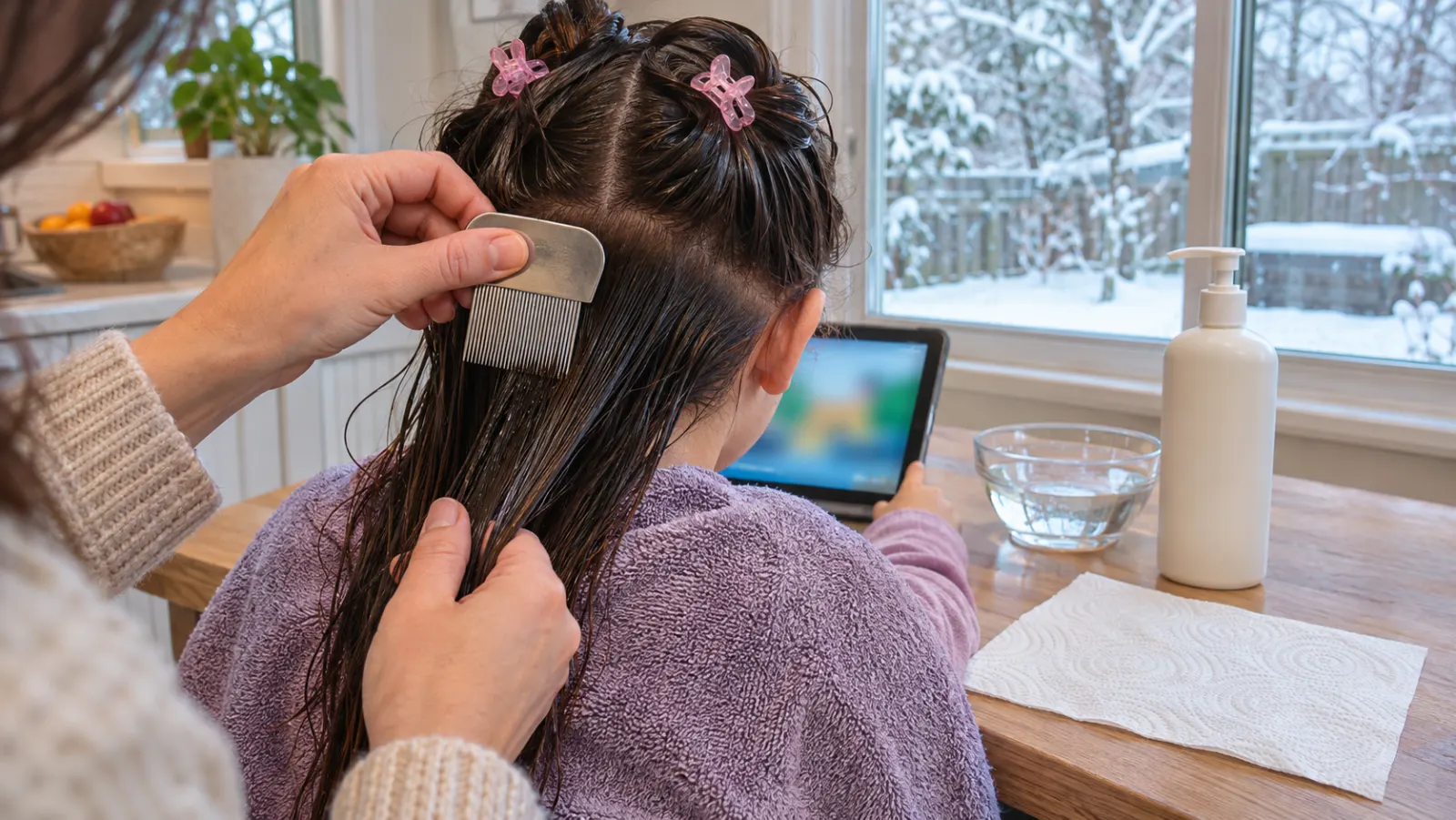
A quick glance under bright lights will not usually find lice. They move quickly and avoid light. The most reliable method is wet combing, which doubles as part of treatment.
What you need
- A fine-toothed lice comb, ideally metal with long teeth spaced closely together (sold at pharmacies)
- Regular conditioner, any brand
- A wide-toothed comb or brush for detangling
- A white paper towel or tissue
- Good lighting, and something to keep your child entertained
Step by step
- Wet your child’s hair and apply plenty of conditioner. It stuns lice briefly and makes them easier to catch, and it makes combing far less painful.
- Detangle with a regular wide comb.
- Divide the hair into small sections. Clip away the parts you have not done yet.
- Starting right at the scalp, draw the lice comb slowly through each section to the ends.
- After every stroke, wipe the comb on the white paper towel and look for lice.
- Work methodically around the whole head, paying extra attention behind the ears and at the back of the neck.
- Rinse the hair. Wash the comb in hot, soapy water.
The whole process takes 15 to 30 minutes for most heads, longer for very long or thick hair.
Telling nits from everything else
Dandruff, hair spray residue and dry skin flakes can easily be mistaken for nits. A nit is glued to the hair shaft and will not brush or flick off easily; flakes slide off. Nits found further than about a centimetre from the scalp are usually empty shells or dead eggs from an old infestation and do not by themselves mean lice are still active.
The key finding is a live louse. If you see live crawling lice, your child has an active infestation. Nits alone, especially far from the scalp, do not always mean treatment is needed. If you are not sure, ask your pharmacist or clinician to take a look.
Check everyone at home
When one child has lice, check every person in the household with the wet combing method, including parents and grandparents. Only treat those who have live lice. Treating people “just in case” is unnecessary and exposes them to products they do not need.
Treatment options that work
Several treatments are available in Canada without a prescription. Your pharmacist can help you choose one based on your child’s age, health, and any allergies. Read and follow the package instructions exactly.
Products that kill lice by blocking their breathing
Some newer products work physically rather than chemically. They coat the lice and either suffocate them or dissolve their protective outer layer. Examples include products based on dimeticone (a silicone oil) and isopropyl myristate. Because they work physically, resistance is less of a concern, and many families find them a good first choice.
Insecticide-based products
Products containing permethrin or pyrethrins have been used for decades. They are safe when used as directed, but lice in some communities have developed resistance to them, so they may not work as reliably as they once did. People with allergies to chrysanthemums or ragweed should ask their pharmacist before using pyrethrin products.
The second treatment matters
No product reliably kills every egg. That is why most treatments are repeated about seven to ten days after the first one, to catch lice that hatched in the meantime before they can lay new eggs. Check the specific product’s instructions for the exact timing. Skipping the second treatment is one of the most common reasons lice come back.
Special situations
Check with a clinician or pharmacist before treating:
- Babies and toddlers, especially those under two
- Anyone who is pregnant or breastfeeding
- Anyone with broken, raw or infected skin on the scalp
- Anyone with asthma or significant allergies
- Lice in eyebrows or eyelashes, which needs a different approach
What to avoid
- Never use kerosene, gasoline, pet flea products or garden insecticides. These are dangerous.
- Do not use a hair dryer on a scalp that has a flammable product on it.
- Do not use more product than directed or repeat treatments more often than recommended. More is not better.
- Do not use lice products as a “preventive.”
Home remedies like mayonnaise, olive oil or tea tree oil are popular, but there is little solid evidence that they work on their own. Some essential oils can irritate the skin. If you want to avoid chemical products altogether, careful wet combing every few days over two weeks is a legitimate option and has evidence behind it, though it takes dedication.
Combing: the unglamorous hero
Whatever treatment you choose, combing ties it all together. Consider a combing schedule like this:
- Comb on the day of treatment to remove dead lice and as many nits as possible.
- Comb every two to three days for the next two weeks.
- Keep combing until you go a full week or so without finding a single live louse.
Combing will not be the most exciting part of your week, but it can be turned into something pleasant. Put on a movie, settle in with a snack, or let your child watch a show on the tablet. Some families end up enjoying the quiet time together.
You do not need to deep-clean your home
This is where many families lose hours, money and sleep. Because lice die quickly off the scalp, a massive cleaning effort is not necessary. Fumigating sprays for furniture and carpets are not recommended; they add chemical exposure without meaningful benefit.
A reasonable, limited approach:
- Wash pillowcases, hats, scarves and towels used by the affected person in the last day or two, in hot water, and dry them on a hot setting.
- Items you cannot wash, like a favourite stuffed animal or a bike helmet, can be sealed in a bag for a couple of weeks, or simply set aside for a few days.
- Soak combs and brushes in hot water for several minutes.
- Vacuum the spot where your child usually lies on the couch, if it makes you feel better.
That is it. You do not need to bag every toy, launder every coat in the closet, or cancel the grandparents’ visit.
Back to school, with no shame
Head lice can affect any family, in any neighbourhood, regardless of income or how often hair gets washed. Scarborough’s schools bring together children from every background, and lice do not care about any of them. Yet stigma persists, and some children are teased or feel embarrassed.
A few points that help:
- In Canada, paediatric experts advise that children with lice do not need to be sent home early or kept out of school. By the time lice are found, they have usually been there for weeks, and the risk to classmates is low. Your child’s school may have its own policy, so check with the office.
- Many health authorities also discourage “no-nit” policies that keep children home until every nit is gone, because they cause missed school without reducing spread.
- Let the school know discreetly so other families can check their children.
- Tell close contacts, such as the parents of children from a recent sleepover. It is a kindness, not a confession.
Talk to your child in a matter-of-fact way. Explain that lice are common, that they are not dirty, and that the whole family will deal with it together. Encourage them not to share hats, hair accessories or headphones for a while, without making it sound like a punishment.
Newcomer families
If your family has recently arrived in Canada, head lice notices from school may be unfamiliar, and products sold here may differ from those you know. Pharmacists in Scarborough can explain the options in plain language, and it is always fine to ask whether someone can help in your preferred language.
When to see a doctor
Most lice can be treated at home with pharmacy products. Book an appointment if:
- You have completed two full rounds of treatment correctly and still find live lice
- The scalp looks infected, with pus, crusting, spreading redness or swollen glands
- There are lice in the eyebrows or eyelashes
- Your child is very young, or anyone affected is pregnant
- You are not sure whether what you are seeing is lice, dandruff or a skin condition such as eczema or psoriasis
- Itching persists for more than a couple of weeks after successful treatment
A little itch can continue for a week or more after the lice are gone, as the skin settles. That alone does not mean the treatment failed.
Help from HealthSmart Medical in Scarborough
If you would like a second set of eyes, our clinicians can confirm whether lice are present, check for skin infection, and talk you through a treatment plan that suits your child’s age and health. We see children and families for children’s health concerns and childhood illness treatment, and our walk-in clinic is there when you need advice the same day.
HealthSmart Medical is at 2425 Eglinton Ave. East, Unit 12. Call 416-757-7117, drop in, or book online. Bring your questions, and leave the embarrassment at home.
This article is for general information and is not a substitute for medical advice. If you have severe or worsening symptoms, call 911 or go to the nearest emergency department.