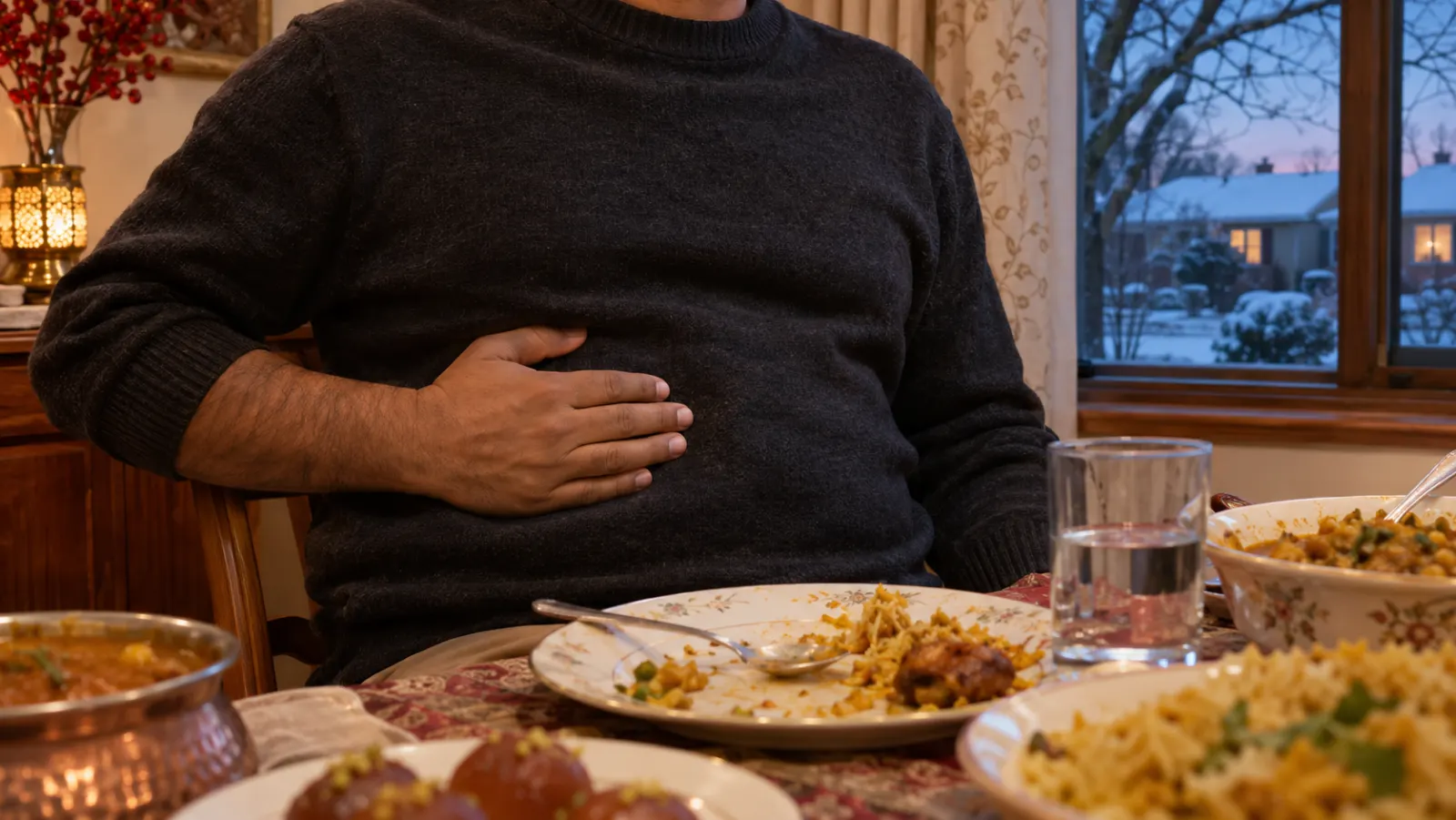
It often starts after a big dinner. Maybe it is a celebration with family, a plate of fried snacks at a gathering, or a late takeout meal after a long shift. An hour or two later, a deep, steady ache settles in under the right side of the ribs or in the middle of the upper belly. It builds, it does not ease when you change position, and it may spread to the back or right shoulder blade. A few hours later it fades, leaving you sore, tired and wondering what just happened.
That pattern is the classic story of a gallbladder attack, usually caused by gallstones. Gallstones are very common, especially as people get older, and many people carry them for years without knowing. It is only when a stone blocks the flow of bile that trouble starts.
This guide explains what the gallbladder does, who tends to get gallstones, how the diagnosis is usually made in Ontario, and how to tell a painful but manageable attack from one that needs emergency care. As the holiday season gets going in Scarborough, with its parade of rich meals, it is a timely topic.
A small organ with one main job
The gallbladder is a small, pear-shaped pouch tucked under the liver on the right side of the upper abdomen. The liver makes bile, a greenish fluid that helps digest fats, and the gallbladder stores and concentrates it between meals. When you eat, especially something fatty, the gallbladder squeezes and pushes bile through a set of narrow tubes, called bile ducts, into the small intestine.
Gallstones form when substances in bile, mostly cholesterol, and sometimes a pigment called bilirubin, harden into small crystals that grow into stones. They can be as small as a grain of sand or as large as a golf ball. Some people have one stone; others have dozens.
Most of the time stones sit quietly. Problems happen when the gallbladder contracts against a stone lodged in its outlet, or when a stone escapes into the ducts and gets stuck.
Who is more likely to get gallstones
Anyone can develop gallstones, but some factors raise the odds:
- Being female. Estrogen affects cholesterol levels in bile, so women are more likely to develop stones, particularly during the childbearing years.
- Pregnancy and hormone use. Pregnancy, and to some extent hormonal birth control or hormone therapy, can increase the risk.
- Age. Gallstones become more common from middle age onward.
- Family history. Gallstones tend to run in families.
- Higher body weight, particularly around the middle.
- Rapid weight loss. Losing a lot of weight quickly, whether through very low-calorie diets, certain medications or weight-loss surgery, can trigger stone formation.
- Diabetes and insulin resistance.
- Certain backgrounds. Some populations, including some Indigenous and Latin American communities, have higher rates of gallstones.
- Some medical conditions, including certain blood disorders, liver scarring and conditions that affect the small intestine.
You cannot change your age or your genes, but you can work on the factors that are within reach, which we cover below.
What a gallbladder attack feels like
Doctors often call the typical gallstone pain biliary colic, though “colic” is misleading, because the pain is usually steady rather than coming in waves. Typical features include:
- Pain in the upper right belly, under the ribs, or in the centre of the upper belly just below the breastbone
- Pain that builds over minutes and then holds at a constant, strong level
- Lasting from about half an hour to several hours, then easing
- Spreading to the back, between the shoulder blades, or to the right shoulder
- Nausea, sometimes vomiting
- Often, but not always, starting after a large or fatty meal, or waking you up at night
Between attacks, most people feel completely normal. Attacks may happen once and never again, or they may return days, weeks or months later. Once someone has had one attack, more are common.
Things that can feel similar
Upper belly pain has a lot of possible causes, and the location alone is not enough to be sure. Heartburn and reflux, stomach ulcers, pancreatitis, kidney stones, liver inflammation, and even muscle strain can produce pain in a similar area. Importantly, heart problems can sometimes show up as upper belly discomfort, nausea and sweating, especially in women, older adults and people with diabetes.
If pain in the upper belly or chest comes with shortness of breath, sweating, light-headedness, or pressure that spreads to the arm, jaw or neck, call 911. Do not assume it is your gallbladder.
When it is no longer just an attack: urgent warning signs
An uncomplicated gallbladder attack settles on its own within a few hours. Complications happen when a stone causes inflammation or infection, or blocks a duct for a longer time. Go to the emergency department, or call 911 if you are very unwell, if you notice:
- Pain lasting more than about five or six hours, or pain that keeps getting worse
- Fever or chills along with upper right belly pain, which can mean the gallbladder is inflamed or infected
- Yellowing of the skin or the whites of the eyes (jaundice). On darker skin, the yellow tint is often easiest to see in the whites of the eyes, under the tongue or on the palms.
- Dark, tea-coloured urine or pale, clay-coloured stools
- Severe pain in the upper belly spreading straight through to the back, especially with vomiting, which can be a sign of pancreatitis
- Confusion, a racing heart or feeling faint
- Vomiting so persistent you cannot keep fluids down
A combination of fever, jaundice and right-sided belly pain is particularly worrying, because it can mean an infection in the bile ducts. That needs hospital care the same day.
Our walk-in clinic is a good place for a recent attack that has already settled, but it is not the right place for the warning signs above. Those belong in an emergency department, where scans, blood tests and intravenous treatment are available.
How gallstones are diagnosed
If you have had a suspected attack that has passed, book an appointment. Bring a description of what happened: when the pain started, where it was, how long it lasted, what you had eaten, and whether you had fever or noticed any yellowing.
The visit
A clinician will ask about your symptoms and medical history and examine your abdomen. They will want to rule out other causes and check for signs of complications. It helps to mention any recent weight loss, pregnancy, new medications or family history of gallbladder problems.
Blood work
Blood tests can check liver function, signs of inflammation or infection, and pancreatic enzymes. These help show whether a stone may be blocking a duct or affecting the pancreas. We can provide a requisition for laboratory testing at a community lab.
Ultrasound
An abdominal ultrasound is the main test for gallstones. It is painless, uses no radiation and is very good at spotting stones in the gallbladder, along with any thickening of the gallbladder wall or widening of the bile ducts. HealthSmart Medical does not perform ultrasounds on site, but we can arrange a requisition through our diagnostic imaging referrals so you can have it done at an imaging centre. You will usually be asked to fast for several hours before the scan, because a recently emptied gallbladder is harder to see. The imaging centre will give you specific instructions.
Other tests
Sometimes additional imaging, such as a CT scan, a specialized MRI of the bile ducts, or a nuclear medicine scan of gallbladder function, is needed. These are generally arranged by a specialist or in hospital, depending on the situation.
Stones found by accident
Many people learn they have gallstones when an ultrasound is done for another reason, such as checking the liver or kidneys. If you have gallstones but have never had symptoms, treatment is usually not needed. Your clinician will explain what symptoms to watch for.
Treatment: what usually happens next
Managing attacks in the short term
For a mild attack, pain relief recommended by your clinician and resting with an empty stomach for a few hours may be enough while it passes. Some people find that smaller, lower-fat meals reduce how often attacks happen while they wait for a specialist appointment. This does not dissolve stones, but it may buy some comfort.
Do not take large amounts of over-the-counter pain medicine to push through repeated attacks without speaking to a clinician. If the usual measures are not helping, that itself is a reason to be assessed.
Surgery
For people who have had symptoms from gallstones, the usual long-term treatment is removing the gallbladder, an operation called a cholecystectomy. In most cases it is done laparoscopically, through a few small incisions with a camera, and many people go home the same day or the next. Your family doctor can make a referral to a general surgeon, who will discuss whether surgery is recommended, the timing, and the risks and benefits for you specifically.
People often worry about living without a gallbladder. Bile still flows from the liver into the intestine; it just drips steadily instead of being stored. Most people eat normally afterward. Some notice looser stools for a while, especially after fatty meals, and this often improves with time.
If a stone is stuck in a bile duct, a procedure done through an endoscope passed down through the mouth may be used to remove it, usually in hospital.
Other options
Medication that slowly dissolves certain cholesterol stones exists, but it works only in selected cases, takes a long time, and stones often come back after stopping. It is generally reserved for people who cannot have surgery. Your specialist can advise whether it applies to you.
Can you lower your risk?
There is no guaranteed way to prevent gallstones, but some habits may help:
- Aim for a healthy weight through gradual changes rather than crash diets
- If you are losing weight, do it steadily rather than very quickly, and talk to your clinician if you are on a rapid weight-loss plan or medication
- Eat regular meals rather than long fasts followed by very large meals
- Choose plenty of fibre from vegetables, fruit, legumes and whole grains
- Favour healthier fats, such as olive oil, nuts and fish, over heavily fried foods
- Stay physically active, even with short daily walks through a Scarborough winter
Gallbladder concerns in Scarborough: getting checked at HealthSmart Medical
A single gallbladder attack is often a warning that more may follow, so it is worth having it looked at, even if you feel fine now. Many people in Scarborough put off a visit until the pain becomes frequent, but sorting out the diagnosis early means you can plan around surgery rather than having it happen as an emergency.
HealthSmart Medical can assess your symptoms, arrange blood work and an ultrasound requisition, and refer you to a surgeon if needed through our general medical consultations. Visit us at 2425 Eglinton Ave. East, Unit 12, call 416-757-7117, or book online. And if pain comes with fever, yellow eyes or dark urine, skip the appointment and go straight to the emergency department.
This article is for general information and is not a substitute for medical advice. If you have severe or worsening symptoms, call 911 or go to the nearest emergency department.