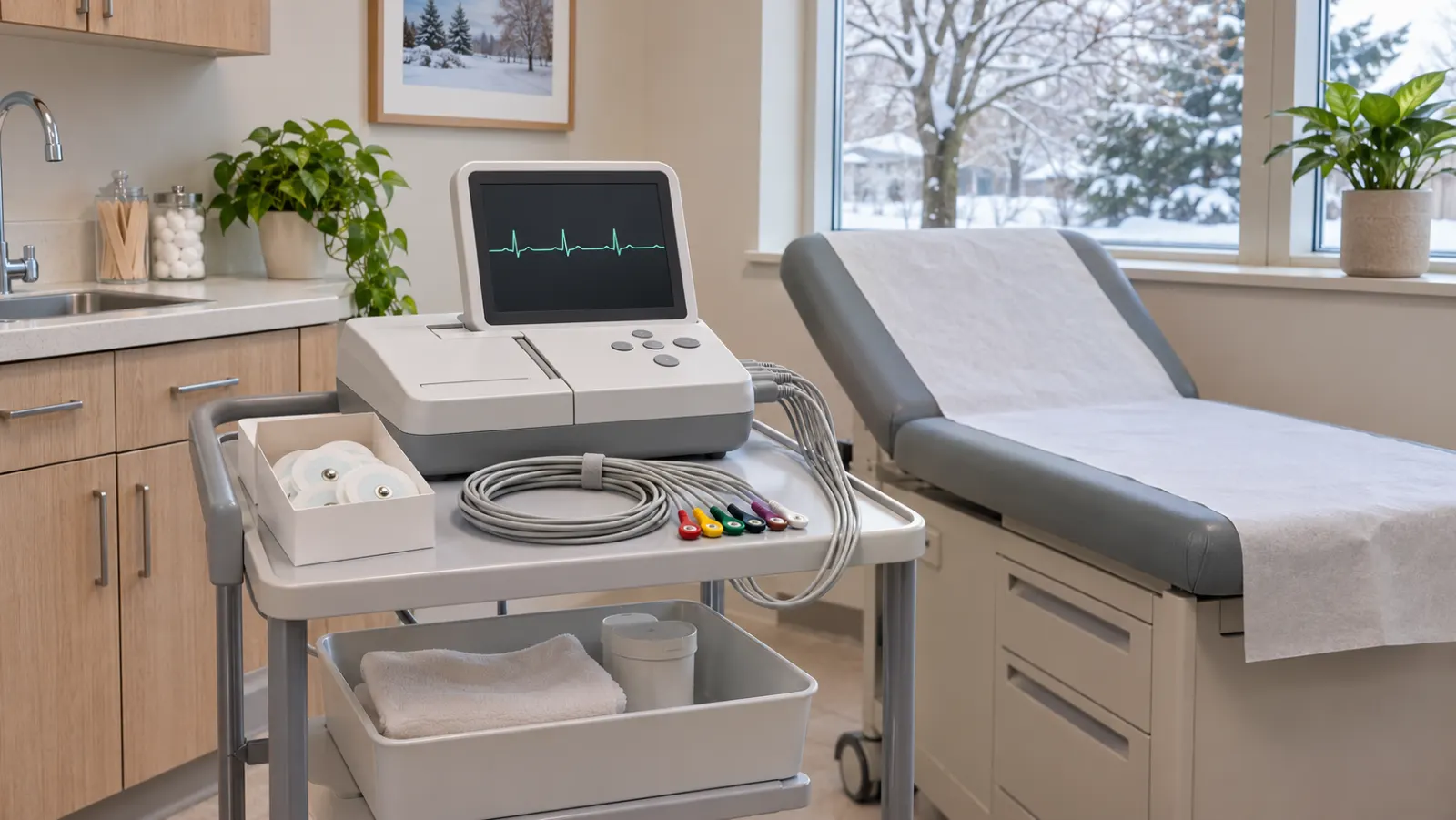
You mention a fluttering feeling in your chest, or you hand over a pre-surgery form, or you simply come in for a check-up, and the clinician says, “Let’s get an ECG.” For many people, that short sentence brings a flicker of worry. Does the doctor think something is wrong with my heart? Will it hurt? What are those stickers for?
An electrocardiogram, usually called an ECG (and sometimes an EKG), is one of the most common tests in medicine. It is quick, painless, and does not involve needles or radiation. It is also widely misunderstood. Some people assume it can detect every heart problem, while others worry that being sent for one means the news must be bad. Neither is true.
This guide explains what an ECG is, why a clinician in Scarborough might recommend one, what actually happens during the test, and what the results can and cannot tell you. It is general information to help you feel prepared, not a way to read or interpret your own tracing.
The heart’s electrical system in plain terms
Every heartbeat starts with a tiny electrical signal. It begins in a natural pacemaker in the upper right chamber of the heart, spreads across the upper chambers (the atria), passes through a relay point in the middle, and then travels down into the lower chambers (the ventricles), causing them to squeeze and pump blood to the rest of the body.
This happens around 60 to 100 times a minute at rest for most adults, over and over, without you thinking about it. An ECG records that electrical activity from the surface of the skin and turns it into a wavy line on paper or a screen. Each part of the wave corresponds to a different step in the heartbeat.
It is worth stressing one thing that surprises many patients: the ECG only listens. It does not send electricity into your body. The sensors simply pick up signals that your heart is already producing.
Why a clinician may suggest an ECG
There are many reasons an ECG might be part of your care, and most of them are routine. Common ones include:
- Palpitations. A racing, pounding, fluttering, or skipping heartbeat.
- Dizziness or fainting. Particularly if it happens suddenly or with exertion.
- Chest discomfort. When the symptoms are stable and not an emergency, as part of a wider assessment.
- Shortness of breath. Especially if it is new or getting worse with activity.
- High blood pressure or diabetes. These can affect the heart over time, and a baseline ECG gives a reference point.
- Medication monitoring. Some medications can affect heart rhythm or the timing of electrical signals, so an ECG may be checked before starting them or after a dose change.
- Before surgery or a procedure. Surgeons and anaesthetists sometimes request a recent ECG, depending on your age and health.
- Forms and assessments. Certain employment, licensing, or insurance processes may ask for one.
- Follow-up of a known heart condition. To compare with earlier tracings and check for changes.
Sometimes the reason is simply that you have several risk factors, such as a family history of heart disease, smoking, or high cholesterol, and your clinician wants a fuller picture during a heart health review.
When an ECG cannot wait for a clinic appointment
An ECG at a family practice or walk-in clinic is meant for stable concerns. It is not the right place to go if you might be having a heart attack or another emergency.
Call 911 right away if you have:
- Chest pain, pressure, squeezing, or heaviness, especially if it lasts more than a few minutes or comes and goes
- Pain spreading to the arm, neck, jaw, back, or upper stomach
- Severe shortness of breath
- Cold sweat, nausea, or light-headedness with chest discomfort
- Fainting, or a racing heartbeat with feeling faint
- Sudden weakness, facial drooping, or trouble speaking
Paramedics can do an ECG in the ambulance and alert the hospital before you arrive. Do not drive yourself, and do not wait to see if it passes. In winter, after shovelling heavy snow is one situation where people sometimes ignore warning signs; please do not.
What happens during the test
The whole process is usually short, and the recording itself takes only a few minutes.
Getting ready
You will be asked to lie down on an exam table. To place the sensors, the person doing the test needs access to your chest, wrists or upper arms, and ankles or lower legs. You may be asked to remove your top and wear a gown open to the front. If you prefer a clinician of a particular gender or would like a chaperone, it is perfectly reasonable to ask.
Placing the electrodes
Small, sticky pads called electrodes are attached to the skin, usually ten in total: six across the chest and one on each arm and leg. These are connected by wires to the ECG machine. If the skin is oily, damp, or has lotion on it, it may be wiped clean first. Sometimes a small area of chest hair needs to be trimmed so the pads stick well.
The recording
Once the pads are on, you will be asked to lie still, breathe normally, and avoid talking. Movement, shivering, or tensing your muscles can create interference on the tracing. If the room is cool, which can happen on a cold February day, let the staff know so they can offer a blanket.
The recording itself takes only a few seconds once everything is connected. Afterward, the pads are peeled off. They can feel a bit like removing a bandage, and they sometimes leave a faint mark that fades quickly.
How to prepare
Preparing for a standard resting ECG is simple. A few practical tips:
- Skip body lotion or oil on your chest, arms, and legs on the day of the test.
- Wear a two-piece outfit so you only need to remove your top. Loose pants that can be pushed up at the ankle make things easier too.
- Avoid tight stockings or tights if possible, since electrodes may need to go on your lower legs.
- Take your usual medications unless a clinician has told you otherwise. Do not stop heart or blood pressure medications on your own.
- Bring a full medication list, including supplements and over-the-counter products.
- Bring previous ECGs or heart reports if you have them. Comparing with an older tracing is one of the most useful things a clinician can do.
- Bring any form or request from a surgeon, employer, or other provider who asked for the ECG.
If you are coming in because of palpitations, it helps to write down when they happen, how long they last, what they feel like, and whether they come with dizziness or chest discomfort. Readings from a smartwatch or home device can be useful to show your clinician, though they do not replace a proper assessment.
What an ECG can show
An ECG gives a snapshot of your heart’s electrical activity during those few seconds. A clinician looks at several things, including:
- Heart rate. Whether it is too fast, too slow, or within the expected range.
- Rhythm. Whether the beats are regular and following the usual electrical path. Atrial fibrillation, extra beats, and some other rhythm problems can be seen if they are present at the time of the recording.
- Conduction. How quickly signals travel through each part of the heart. Delays or blocks can show up as changes in the shape and spacing of the waves.
- Signs of strain or thickening. Some patterns can suggest that the heart muscle has thickened, often from long-standing high blood pressure.
- Evidence of a past heart attack. Certain changes can suggest that part of the heart muscle was damaged in the past, sometimes without the person knowing.
- Signs of reduced blood flow. In some cases, changes may suggest the heart is not getting enough oxygen.
- Effects of medications or blood salts. Abnormal levels of potassium or calcium, or certain medications, can change the tracing.
What an ECG cannot tell you
This is where expectations often need adjusting. A resting ECG is a useful tool, but it has real limits.
A normal ECG does not rule out heart disease
Many people with narrowed heart arteries have a completely normal resting ECG, because the heart is getting enough blood while they are lying still. Problems may only appear during exertion. That is why a clinician may suggest further testing, such as a stress test, even after a normal result, if your symptoms or risk factors point that way.
It may miss symptoms that come and go
If your palpitations happen twice a week, the chances of capturing one during a few-second recording are low. A normal tracing simply means nothing unusual was happening at that moment. For intermittent symptoms, longer monitoring, such as a portable monitor worn for a day or more, may be recommended.
It does not show the structure of the heart in detail
An ECG does not directly show the heart valves, the pumping strength of the heart, or the size of the chambers. If those questions matter, an echocardiogram (an ultrasound of the heart) may be ordered.
Some findings are minor
ECG computer readouts sometimes flag findings that sound alarming but are common and harmless, or that have been present for years. A clinician interprets the tracing alongside your history, symptoms, and earlier ECGs before deciding what it means. Try not to search the automated wording online before talking it through.
After your ECG
Ask before you leave how your results will be reviewed and how you will hear about them. Depending on the findings and the reason for the test, next steps may include:
- No further action if the tracing is reassuring and fits your symptoms
- Blood work to check electrolytes, thyroid function, blood count, or cholesterol
- A medication review or dose adjustment
- Longer rhythm monitoring or a stress test
- An echocardiogram or other imaging
- A specialist referral to a cardiologist
- Same-day emergency care if the tracing shows something urgent
If your symptoms continue or get worse after a normal ECG, follow up rather than assuming you have been cleared. The test is one piece of information, and your symptoms matter just as much.
A note for families and newcomers
Heart conditions can run in families, and many households in Scarborough include several generations who may share risk factors such as high blood pressure, diabetes, or early heart disease. If a parent or sibling had a heart attack or sudden cardiac death at a young age, tell your clinician. For newcomers, bringing any ECGs or heart reports from your home country, even if they are in another language, can still be helpful for comparison.
Book an ECG assessment in Scarborough
If you have stable symptoms you are worried about, or a form or clinician has asked for an ECG, HealthSmart Medical offers ECG testing as part of a full assessment, so the result is interpreted with your history rather than in isolation. We are at 2425 Eglinton Ave. East, Unit 12. Call 416-757-7117 or book online, and bring your medication list and any earlier heart tests. For chest pain or other emergency symptoms, always call 911 first.
This article is for general information and is not a substitute for medical advice. If you have severe or worsening symptoms, call 911 or go to the nearest emergency department.