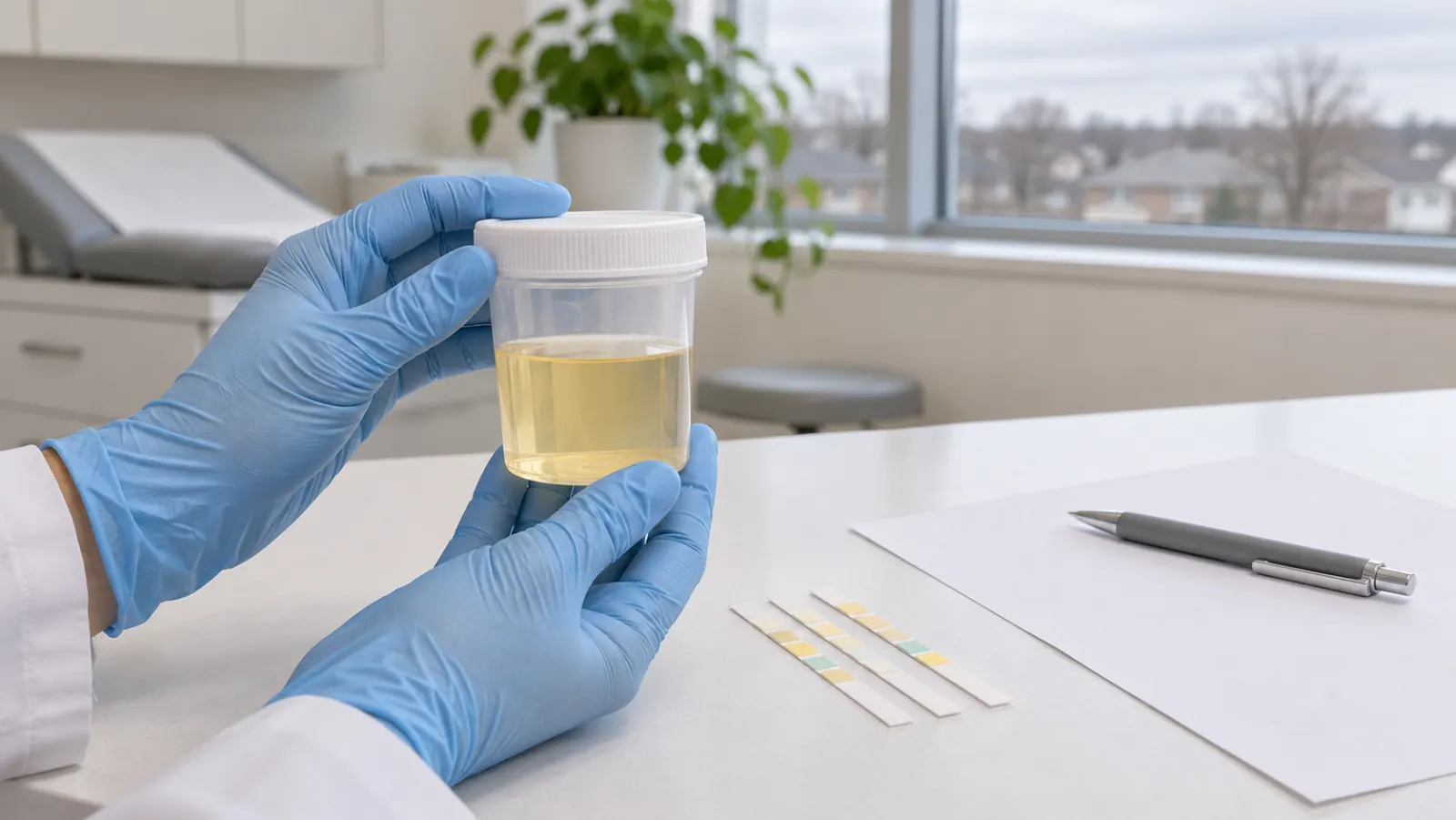
Few things are as alarming as looking down into the toilet bowl and seeing pink, red or brown where there should be yellow. Your mind can jump straight to the worst case. On the other hand, some people learn they have blood in their urine only because a routine test at a check-up picked up something invisible, and they shrug it off because they feel perfectly well.
Both reactions are understandable, and both deserve the same calm response: get it checked. Blood in the urine, which doctors call hematuria, often has a simple, treatable cause, such as a bladder infection or a kidney stone. Sometimes it is caused by something harmless, like hard exercise or a meal of beets. But occasionally it is the first and only sign of a problem in the kidneys or bladder that is much easier to treat when found early.
This article walks through the common causes, the look-alikes that are not blood at all, what testing usually involves in Ontario, and when you should head to an emergency department rather than wait for an appointment. As the snow melts and people in Scarborough start getting back into running, cycling and spring yard work, it is also a good moment to talk about exercise-related causes.
Two kinds of hematuria
Visible blood
When you can see it, it is called gross or visible hematuria. Urine may look pink, red, cola-coloured or brownish, and there may be small clots. It only takes a very small amount of blood to change the colour of urine, so the colour alone does not tell you how much bleeding there is or how serious the cause is.
Blood only seen on testing
When blood is present but not visible, it is called microscopic or non-visible hematuria. It is usually found on a dipstick test at a check-up, a pre-employment medical, an insurance exam, or during investigations for something else. Many people with microscopic hematuria have no symptoms at all.
A single positive dipstick does not necessarily mean there is a problem. Dipsticks can be positive for reasons other than intact red blood cells, so the usual next step is to repeat the test and send a sample to a lab for a closer look under a microscope.
Things that look like blood but are not
Before worrying, it helps to know that red or dark urine is not always blood. Common look-alikes include:
- Foods, especially beets (beeturia), blackberries, rhubarb and some foods with strong red dyes
- Medications, such as phenazopyridine (a bladder pain reliever that turns urine orange-red), rifampin, some laxatives containing senna, and a few others
- Dehydration, which makes urine dark amber or brownish
- Menstrual blood mixing with a urine sample
- Muscle breakdown after extreme exertion, which releases a pigment called myoglobin that can make urine cola-coloured. This one is not harmless and is discussed below.
If the colour change happens once after a bowl of borscht and never again, that is reassuring. If you are not sure, or it recurs, have a urine test.
Common causes of blood in urine
Blood can come from anywhere along the urinary tract: the kidneys, the tubes that drain them (ureters), the bladder, the urethra, and in men, the prostate.
Infections
Bladder infections are among the most common causes of visible blood, especially in women. They usually come with burning, urgency, frequent small trips to the washroom and lower belly discomfort. Kidney infections add fever, chills and flank pain. A urine test confirms the infection, and treatment is usually straightforward; our UTI treatment page has more on that part. After treatment, it is often worth re-checking the urine to make sure the blood has cleared, particularly in older adults.
Kidney stones
Stones can cause visible or microscopic blood, often along with severe, wave-like pain in the side or back that may spread into the groin. Some people pass small stones with only mild symptoms.
Exercise
Hard or prolonged exercise, such as distance running, can sometimes cause blood in the urine for a day or so. This is generally harmless and clears within 24 to 72 hours. If it does not clear, or keeps happening, it should be investigated rather than put down to training.
Separately, extreme exertion, especially in heat, or after crush injuries, can cause muscle breakdown called rhabdomyolysis. It produces dark, cola-coloured urine along with severe muscle pain and weakness. This needs same-day emergency assessment because it can damage the kidneys.
Enlarged prostate
In men over about 50, an enlarged prostate is a common source of bleeding, often alongside a weak stream, getting up at night or difficulty emptying. Blood still needs to be investigated rather than assumed to be from the prostate. Our prostate health assessments can be part of that picture.
Kidney conditions
Some kidney diseases, such as inflammation of the kidney’s filters (glomerulonephritis), cause blood in the urine, often along with protein, rising blood pressure or swelling in the legs. IgA nephropathy, one of the more common examples, sometimes shows up as visible blood a day or two after a sore throat or cold. Inherited conditions like polycystic kidney disease can also cause bleeding.
Medications and blood thinners
People taking blood thinners may notice blood in the urine more easily. These medications do not usually cause bleeding by themselves, though; they tend to reveal an underlying source. So blood in the urine on a blood thinner still needs the same investigation. Do not stop a blood thinner on your own; call your clinician.
Other causes
Recent procedures like a catheter or cystoscopy, a recent injury to the back or abdomen, sickle cell trait or disease, and certain infections acquired abroad, such as schistosomiasis, are less common causes. That last one is worth mentioning to your clinician if you have lived in or travelled to parts of Africa or the Middle East and swum in fresh water, which matters for some newcomers and frequent travellers in Scarborough.
Cancer
This is the cause everyone fears, so it is worth being direct. Bladder cancer, kidney cancer and, less often, cancers of the prostate or ureters can cause blood in the urine, sometimes painless and sometimes on and off. That is exactly why doctors take hematuria seriously even when it goes away. The risk is higher with:
- Older age
- Smoking, now or in the past, which is the biggest single risk factor for bladder cancer
- Long-term workplace exposure to certain chemicals, such as those in dyes, rubber, leather, textiles, paint and some industrial processes
- Previous pelvic radiation or some chemotherapy drugs
- A family history of kidney or bladder cancer
Most people with blood in the urine do not have cancer. But painless, visible blood in an adult, especially one with these risk factors, should always lead to further testing, even if it happened only once and stopped.
When to go to the emergency department
Seek emergency care the same day if you have blood in your urine along with:
- Large clots, or you cannot pass urine at all
- Severe pain in the side, back or belly that is not controlled
- Fever with flank pain, chills or vomiting
- Dizziness, fainting or a racing heart
- Dark, cola-coloured urine with severe muscle pain after intense exercise or an injury
- A recent fall, accident or blow to the back or abdomen
- Significant bleeding while on a blood thinner
Call 911 if someone is very weak, confused or collapsing.
How blood in urine is investigated
For visible blood without emergency signs, or a positive test that needs follow-up, book a visit. Our walk-in clinic can get the process started the same day.
Your story
Your clinician will ask when you noticed the blood, whether it was at the start, end or throughout urination, whether there were clots, pain or fever, and about recent exercise, infections, foods, medications, smoking history, occupation and travel. For women, the timing in relation to periods matters.
Urine tests
These are the backbone of the workup:
- Urinalysis, which checks for blood, protein, sugar and signs of infection
- Urine microscopy, to confirm red blood cells are really present and look at their shape, which can hint at a kidney source
- Urine culture, to identify any infection
- Sometimes urine cytology, which looks for abnormal cells
If an infection is found and treated, the urine is usually re-tested a few weeks later to make sure the blood is gone.
Blood tests
Blood work checks kidney function, blood counts and sometimes clotting. We can arrange laboratory testing at a community lab with a requisition. Your blood pressure will also be measured, since high blood pressure can go along with kidney problems.
Imaging
An ultrasound of the kidneys and bladder is commonly ordered first. Depending on your age and risk factors, a CT scan may be recommended to look at the whole urinary tract in more detail. We do not perform imaging on site, but we provide requisitions for imaging centres.
Cystoscopy and referral
For many adults with visible blood, and for some with persistent microscopic blood, the next step is a cystoscopy, where a urologist looks directly inside the bladder with a thin camera. It is usually done with local anaesthetic and is quick. If tests point toward a kidney cause, such as protein in the urine or reduced kidney function, the referral may be to a kidney specialist (nephrologist) instead.
Your doctor can confirm current Ontario guidance on who needs which tests, since recommendations depend on age, sex, risk factors and test results. Referrals are made through our specialist referrals service.
What if everything comes back normal?
Sometimes a full workup finds no cause, particularly for microscopic blood in younger adults. That is generally reassuring. Your clinician may suggest repeat urine tests and blood pressure checks over time, and will tell you what changes should prompt a return visit, such as visible blood, new symptoms or rising blood pressure.
Habits that support your urinary tract
There is no guaranteed way to prevent every cause of hematuria, but some habits help:
- Do not smoke, and get help to quit if you do
- Drink enough fluid to keep urine pale yellow, which also helps prevent stones
- Use protective equipment and follow safety rules if your work involves chemicals
- Keep blood pressure and blood sugar in range, which protects the kidneys
- Build up exercise gradually and stay hydrated, especially once warmer weather arrives
- Go to your regular check-ups, where a simple urine test can catch problems early
Getting a urine concern looked at in Scarborough
Blood in the urine is a symptom, not a diagnosis, and it is almost always worth a conversation with a clinician, even when it has already stopped. The most likely answer is often simple, but the only way to know is to test.
At HealthSmart Medical in Scarborough, we can examine you, test your urine, arrange blood work and imaging requisitions, treat infections, and refer you to a urologist or kidney specialist when needed. Visit us at 2425 Eglinton Ave. East, Unit 12, call 416-757-7117, or book online. If you have large clots, cannot pass urine, or have severe pain or fever, go to the emergency department instead.
This article is for general information and is not a substitute for medical advice. If you have severe or worsening symptoms, call 911 or go to the nearest emergency department.