By late July, Pearson is packed with Scarborough families heading out on the longest flights of their year. Toronto to Delhi, Colombo, Manila, Hong Kong, Dubai or Accra often means twelve to sixteen hours in the air, sometimes with a layover that adds another long leg. Most people step off the plane with nothing worse than stiff knees, puffy ankles and jet lag. A small number develop something more serious: a blood clot in a deep vein of the leg.
Clots linked to travel are not common, and fear of them should not stop anyone from visiting family or taking a well-earned holiday. But they are worth understanding, because the people most at risk are often the very travellers who board long-haul flights out of Toronto every summer: grandparents with heart or lung conditions, people recovering from surgery, pregnant women flying home to be near their mothers, and anyone who will sit wedged in a window seat for most of a day.
This article explains why long journeys raise clot risk, who should think about it more carefully, what you can do on the plane, and the symptoms that mean you should get help right away. It is general education. If you have a personal history of clots or a condition that worries you, talk it through with a clinician before you fly.
What a travel-related clot actually is
Deep vein thrombosis, usually shortened to DVT, is a blood clot that forms in one of the larger veins deep inside the body, most often in the calf or thigh. Blood in the leg veins relies on the squeezing action of your calf muscles to push it back up toward the heart. When you sit still for hours with your knees bent, that pump slows down. Blood pools, flows more sluggishly, and in some people a clot begins to form.
The bigger concern is what can happen next. Part of a clot can break off and travel through the bloodstream to the lungs. This is called a pulmonary embolism, or PE, and it is a medical emergency. Together, DVT and PE are sometimes grouped under the term venous thromboembolism.
Why the length of the trip matters
The risk is linked to long periods of immobility rather than to flying as such. A long bus ride, a road trip to Montreal or a full day squeezed into a train can do the same thing. Generally, journeys of more than about four hours are where the conversation starts, and the risk climbs with longer and back-to-back legs. The dry cabin air and the tendency to drink less water (or more coffee and wine) on board may add to the problem, although immobility is the main driver.
Clots can appear after you land
Many people assume a clot would show itself during the flight. In fact, symptoms can start days or even a couple of weeks later. Someone who flies to visit relatives and then spends the first week sitting through long family gatherings, or recovering from jet lag on the sofa, may notice leg pain well after arrival. Keep this in mind on the return trip, too, when you are back in Scarborough and unpacking.
Who should pay closer attention
For a healthy adult with no risk factors, the chance of a serious clot from a single long flight is low. The picture changes when other factors stack on top of a long journey. These include:
- A previous DVT or pulmonary embolism, or a close family member who has had clots
- Recent surgery, especially hip, knee or abdominal surgery, in roughly the past few months
- A recent hospital stay, serious injury, or a leg in a cast or brace
- Active cancer or cancer treatment
- Pregnancy and the weeks after giving birth
- Estrogen-containing birth control or hormone therapy
- Older age
- Obesity
- Heart failure, significant lung disease, or other conditions that limit how much you move
- Some inherited clotting disorders
- Large varicose veins
Having one of these does not mean you should cancel your trip. It means the trip deserves a little more planning, and possibly a conversation with your doctor about whether any extra precautions make sense for you.
A note for families travelling together
In many Scarborough households, one person books everyone’s tickets. If you are the organiser, think about the older parent or the relative who recently had surgery. Asking for an aisle seat for them, building in a stopover on a very long route, or simply reminding them to get up every hour can make a real difference. It also helps to know their medication list in case anyone needs care abroad.
Before you leave home
The best preparation starts a few weeks before departure, not at the gate.
See a clinician if you have risk factors
If you have had a clot before, are on blood thinners, are pregnant, have recently had surgery, or live with a chronic condition such as heart or lung disease, book a visit before you go. A pre-travel medical evaluation is a good opportunity to review clot risk alongside vaccines, malaria tablets and your medication plan. Your clinician may talk about compression stockings, timing your trip around recovery from surgery, or, in selected higher-risk situations, whether medication to prevent clots is appropriate. That last decision is individual and should never be made on your own.
If you already take a blood thinner
Make sure you will not run out while you are away, and keep the medication in your carry-on. If you take warfarin, ask about blood test timing, since changes in diet abroad can affect your levels. Do not skip doses because of the flight or time zone change without guidance on how to adjust.
Choosing compression stockings
Graduated compression stockings, which are tighter at the ankle and looser up the leg, can reduce the chance of a travel-related clot and help with ankle swelling. They need to fit properly to work and to avoid causing problems of their own. Below-knee stockings are typically used for travel. People with certain circulation problems, severe nerve damage in the feet (for example, from diabetes) or skin conditions on the legs should check with a clinician first. A pharmacist or medical supply store can help with measurements.
What to do on the plane
Small habits repeated throughout the flight are the core of clot prevention for most travellers.
Keep your calves working
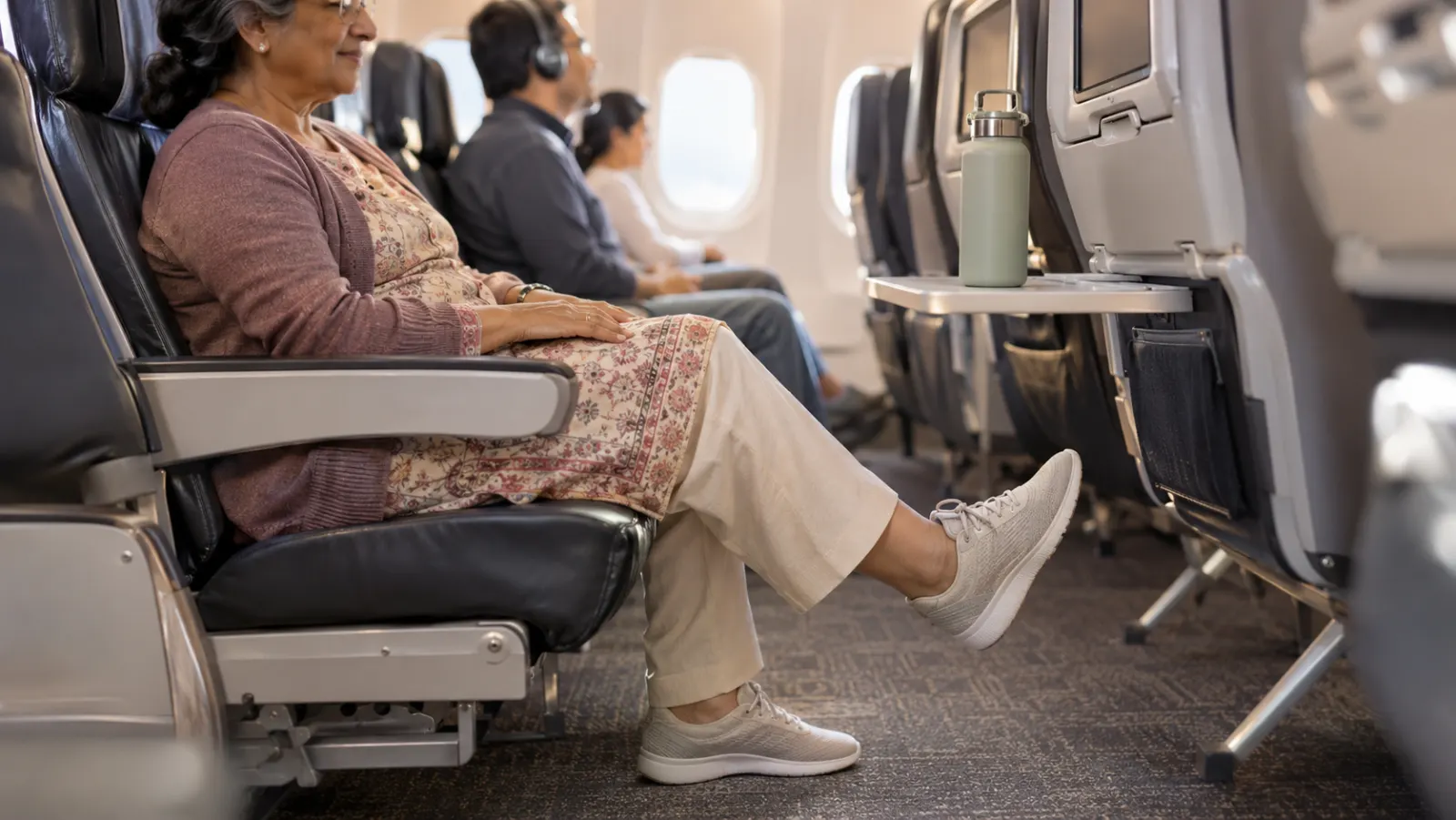
- Every half hour or so, while seated, point and flex your feet, draw circles with your ankles, and press your toes into the floor and lift your heels.
- When the seatbelt sign is off, get up and walk the aisle. Aim for a short walk every hour or two when it is safe to do so.
- Avoid crossing your legs for long periods.
- Keep the space under the seat in front of you clear so you can stretch your legs. A bulky bag at your feet traps your knees at a sharp angle for hours.
Pick your seat with movement in mind
An aisle seat makes it far easier to get up without climbing over two strangers. For older relatives or anyone with risk factors, this is worth requesting when booking or at check-in.
Drink water and go easy on the rest
Staying reasonably hydrated is sensible on any flight. Bring an empty bottle through security and fill it before boarding, or ask the cabin crew for water regularly. Alcohol and lots of caffeine can make dehydration worse and tend to make people sleep deeply in one position for hours.
Think twice about sleeping pills
Sedating medications, including some over-the-counter sleep aids and antihistamines, can leave you sitting completely still for much of the flight. If you need help sleeping on overnight flights, ask your doctor what is safest for you rather than relying on whatever is in the medicine cabinet.
Loose clothing helps
Tight waistbands and clothing that digs in behind the knees can restrict blood flow. Comfortable, loose layers are better, especially since cabin temperatures can swing between chilly and warm.
Swollen ankles versus a clot
Mild swelling in both feet and ankles after a long flight is very common and usually settles within a day or so once you are walking around and putting your feet up. It is caused by fluid shifting into the lower legs when you sit still.
A clot tends to look different. Warning signs of DVT include:
- Pain, tenderness or cramping in one leg, often in the calf, that does not go away
- Swelling in one leg more than the other
- Warmth over the painful area
- Red or darker discolouration of the skin on that leg, which may be harder to see on brown or darker skin; compare the shape and warmth of both legs
The key word is “one”. Swelling or pain confined to a single leg, especially with tenderness, deserves prompt medical assessment. Do not massage a leg you suspect has a clot.
If you are back home in Scarborough and notice these signs, contact a clinician the same day. Our walk-in clinic can assess you and arrange testing, which often means an urgent ultrasound through a hospital or imaging centre. If you are still abroad, see a local doctor and mention your recent long flight.
Pulmonary embolism: call 911
A clot in the lungs can be life-threatening. Call 911 or go to the nearest emergency department right away if you have:
- Sudden shortness of breath with no clear cause
- Chest pain that is sharp or worse when you breathe in deeply or cough
- A rapid heartbeat
- Coughing up blood
- Feeling faint, light-headed or passing out
These symptoms can appear with or without obvious leg symptoms first. Do not wait to see if they improve, do not drive yourself, and do not try to book a regular appointment. If this happens during a flight, tell the cabin crew immediately.
After the trip
Once you land, get moving. A walk around the neighbourhood, even a short one, helps your circulation recover after hours of sitting. Over the following days, keep an eye on your legs and your breathing, especially if you have risk factors.
If you were diagnosed with a clot while abroad, bring all the paperwork you received home with you, including the names and doses of any medications started. Follow-up care matters, because blood thinners need monitoring and a clear plan for how long to continue them. Book a follow-up appointment soon after you return so a clinician can review the treatment and make sure nothing has been missed.
Long drives count too
Summer in Scarborough also means road trips to cottage country, Ottawa, Quebec and the U.S. The same principles apply. Stop every couple of hours, get out, walk around the rest stop and stretch your legs. Passengers can do the seated calf exercises too.
Planning ahead with HealthSmart Medical
A long flight to see the people you love should be a happy event, not a worry. For most travellers, simple habits like walking the aisle, flexing your ankles and drinking water are all that is needed. For those with a higher risk, a short visit before departure can give you a personalised plan.
At HealthSmart Medical, our clinicians see patients in Scarborough for travel preparation, chronic condition reviews and same-day concerns. You can visit us at 2425 Eglinton Ave. East, Unit 12, call 416-757-7117, or book online ahead of your trip. If you ever have sudden chest pain or trouble breathing, skip the clinic and call 911.
This article is for general information and is not a substitute for medical advice. If you have severe or worsening symptoms, call 911 or go to the nearest emergency department.