It might start as what looks like a pimple or an ingrown hair. Over a day or two it becomes larger, redder and more painful, and it throbs when you sit, walk or let your arm brush against something. Eventually it may form a yellowish head that seems to be begging to be squeezed.
That is a boil, or if it is larger and deeper, an abscess: a pocket of pus trapped under the skin. They are very common, they can show up almost anywhere on the body, and they are one of the more uncomfortable reasons people walk into a clinic in Scarborough. Most are caused by bacteria that normally live harmlessly on our skin, particularly Staphylococcus aureus, getting into a hair follicle or a small break in the skin.
The single most important piece of advice in this article is simple: please do not squeeze it, poke it with a needle, or try to cut it open yourself. Below we explain why, what you can safely do at home, how clinicians decide whether you need drainage or antibiotics, and which signs mean an infection is spreading and needs urgent care.
Boil, carbuncle, abscess: what is the difference?
These terms overlap, and people use them loosely. Here is roughly how clinicians think about them.
- Folliculitis: small, often itchy red bumps or pustules around hair follicles. Common after shaving, waxing, sweating or using a hot tub. Usually mild.
- Boil (furuncle): a deeper, painful infection of a single hair follicle that forms a firm red lump and often a pus-filled head.
- Carbuncle: a cluster of boils joined together under the skin, usually on the back of the neck, shoulders or thighs. These are larger, more painful, and more likely to come with fever or feeling unwell.
- Abscess: a collection of pus in the skin or deeper tissue. It may come from a boil, an infected cyst, an ingrown hair, a cut, an insect bite, or an injection site. Abscesses often feel soft or “squishy” in the centre with firm, tender skin around them.
There is also cellulitis, which is not a pus pocket but a spreading infection of the skin and the tissue underneath. It looks like an area of red, warm, swollen and tender skin, often with less defined edges. Cellulitis and abscesses can occur together.
Common places they show up
Boils and abscesses like areas where there is hair, friction and sweat: the armpits, groin, inner thighs, buttocks, back of the neck, and under the breasts. Sitting for long shifts, tight clothing, and shaving or waxing these areas can all contribute. In hot, humid Scarborough summers, or after a sweaty winter of heavy layers on a crowded commute, people often notice more of them.
Why you should not squeeze it
We know. It is tempting. But squeezing, lancing with a pin or cutting into a boil at home can cause real problems:
- You can push bacteria deeper. Pressure on an infected pocket can force bacteria into surrounding tissue and the bloodstream, turning a local infection into a spreading one.
- You rarely empty it fully. Abscesses often have pockets or a thick wall. Squeezing tends to drain only part of the pus while damaging the skin around it.
- You add new bacteria. Fingers, needles and kitchen knives are not sterile.
- It can scar. Damaged skin heals less neatly, especially on the face.
- Some locations are risky. Infections on the face, particularly in the triangle around the nose and upper lip, drain toward veins near the brain. Squeezing these is strongly discouraged.
A boil that opens and drains by itself is a different matter. That often happens after warm compresses and is part of normal healing. The goal is to help it along gently, not force it.
What you can safely do at home
Small, early boils in otherwise healthy people often improve with simple care.
Warm compresses
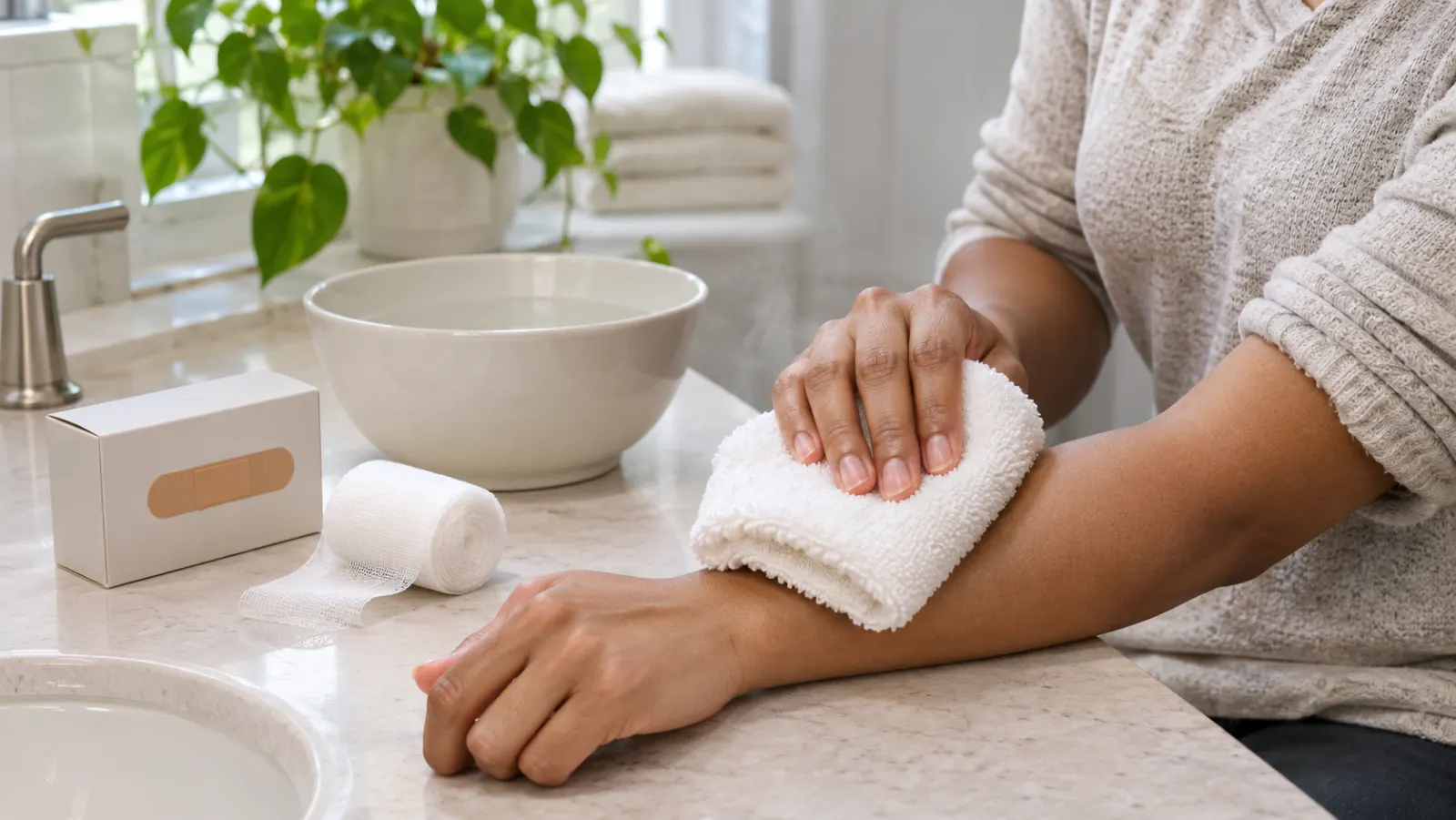
Soak a clean washcloth in warm (not hot) water, wring it out, and hold it on the boil for about 10 to 15 minutes, three or four times a day. Warmth increases blood flow to the area, can ease pain, and may help the boil come to a head and drain on its own. Use a fresh cloth each time, or wash cloths in hot water between uses.
Keep it clean and covered
- Wash your hands before and after touching the area
- If the boil opens, gently clean it with soap and water and cover it with a clean, dry dressing
- Change the dressing whenever it becomes wet or soiled
- Do not share towels, washcloths, razors or bedding while you have a draining boil
- Wash clothing, towels and bedding that have touched the area in hot water
Ease the pain and the friction
Loose, breathable clothing helps, particularly for boils in the groin, armpits or buttocks. Over-the-counter pain relievers may help; follow package directions and ask a pharmacist if you have other health conditions. Avoid shaving over or around the boil until it heals.
What not to rely on
Antibiotic creams from the pharmacy are not usually effective for a boil that has formed under the skin, because the infection is below the surface. Home remedies such as drawing salves or pastes have no reliable evidence and can irritate the skin.
When a boil or abscess needs medical care
See a clinician if:
- The boil is larger than about the size of a grape, or keeps growing
- It has not improved, or has not started draining, after several days of warm compresses
- It is very painful
- It is on your face, near your eye, in your nose, on your hand or fingers, near the rectum or genitals, or over a joint
- You have more than one boil, or a cluster (carbuncle)
- You keep getting boils
- You have diabetes, a weakened immune system, are on steroids or biologic medications, are undergoing cancer treatment, or have poor circulation
- You are pregnant
- A child or baby has a boil, particularly with fever
What the visit involves
At an abscess assessment, the clinician will look at the area, feel for a soft, fluid-filled centre, check how far any redness has spread, and ask about fever, how long it has been there, and any previous boils or antibiotics. Bring a list of your medications and allergies, and mention conditions such as diabetes.
Drainage versus antibiotics
Here is something many people do not expect: for a true abscess, the most important treatment is often drainage, not antibiotics. When pus is walled off under the skin, antibiotics have trouble reaching it, and the pocket may persist even after a full course of pills.
Drainage, when needed, generally involves numbing the skin, making a small opening to release the pus, and sometimes placing a light packing or dressing inside. Whether that can be done in a clinic depends on the size, depth and location of the abscess, your other health conditions, and the equipment available. Some abscesses are better handled in a hospital or by a surgeon. Your clinician will explain what can be done during your visit and what would need a referral, so it is worth calling ahead if you are hoping for same-day treatment.
Antibiotics are more likely to be recommended when:
- Redness and swelling are spreading around the abscess (cellulitis)
- You have a fever or feel unwell
- The abscess is large, there are several, or it is in a difficult location
- You have diabetes, a weakened immune system or other risk factors
- The abscess has not responded to drainage
Sometimes a swab of the pus is sent to the lab to identify the bacteria and which antibiotics will work, which is particularly useful for recurrent infections. If you are prescribed antibiotics, take the full course as directed.
Aftercare
After drainage, the wound often needs regular cleaning and fresh dressings for a while, and sometimes the packing needs to be changed or removed. Our dressing changes and broader minor procedures services can support this follow-up. Expect the area to become less painful within a day or two. Increasing pain, redness or fever after drainage is a reason to be checked again.
When boils keep coming back
Some people get one boil after another, sometimes for months. This is frustrating, and it is worth a proper look rather than treating each one in isolation. Possible factors include:
- Carrying Staph bacteria in the nose or on the skin, sometimes including MRSA, a type that resists some common antibiotics
- Close contact with household members who also get boils, which is common in busy, multigenerational homes and among people who share sports equipment
- Friction and sweat from tight clothing, long periods of sitting, or physical jobs
- Shaving or waxing
- Diabetes, or blood sugar that is not well controlled
- Skin conditions such as eczema
- Hidradenitis suppurativa, a chronic inflammatory condition that causes recurring painful lumps and tunnels in the armpits, groin and under the breasts, and is often mistaken for repeat boils
A doctor may recommend blood work to check blood sugar, a swab culture, and in some cases a decolonization routine, which can involve antiseptic body washes and a nasal ointment for you and sometimes others in your household. If diabetes turns out to be part of the picture, our diabetes management visits can help bring things under control, which often reduces skin infections too.
Signs of a spreading or serious infection
Most boils stay local. But skin infections can occasionally spread into deeper tissue or the bloodstream. Go to an emergency department, or call 911 if you are very unwell, if you notice:
- Red streaks spreading out from the boil toward your heart
- Redness and swelling that are spreading quickly, over hours
- Fever, chills, a racing heart, confusion, or feeling very unwell
- Severe pain that seems out of proportion to how the skin looks
- Skin that turns dusky, purple, blistered or numb
- Swelling or redness around the eye, or a boil on the face with fever or headache
- A painful abscess near the anus or in the genital area with fever
- A rapidly worsening infection in someone with diabetes, a weakened immune system, or poor circulation
Infections in the hand also deserve prompt attention, because the hand’s tight compartments and tendons can be damaged quickly.
Getting a sore lump checked at HealthSmart Medical in Scarborough
Boils and abscesses are miserable, but they are very treatable when handled the right way. Keep your hands off, use warm compresses, keep it clean and covered, and get it looked at if it is large, painful, in a sensitive spot, or not settling.
HealthSmart Medical is at 2425 Eglinton Ave. East, Unit 12, in Scarborough, and our walk-in clinic can assess a painful lump and talk you through the next steps. Call 416-757-7117 or book online. If redness is spreading fast or you feel feverish and unwell, head to emergency instead of waiting.
This article is for general information and is not a substitute for medical advice. If you have severe or worsening symptoms, call 911 or go to the nearest emergency department.